I managed to complete the last of my 28mm Spanish figures over the Easter weekend, in the form of half a dozen Spanish generals and aides-de-camp:
I decided to put them on circular bases, mainly for stability but am quite pleased with the contrast between these and the rectangular bases which I have used for the rest of the army.
I particularly like the way the figure on the right turned out. He just seemed to "emerge" and ended up looking like a Guard or Swiss officer, which wasn't actually planned when work commenced on him:
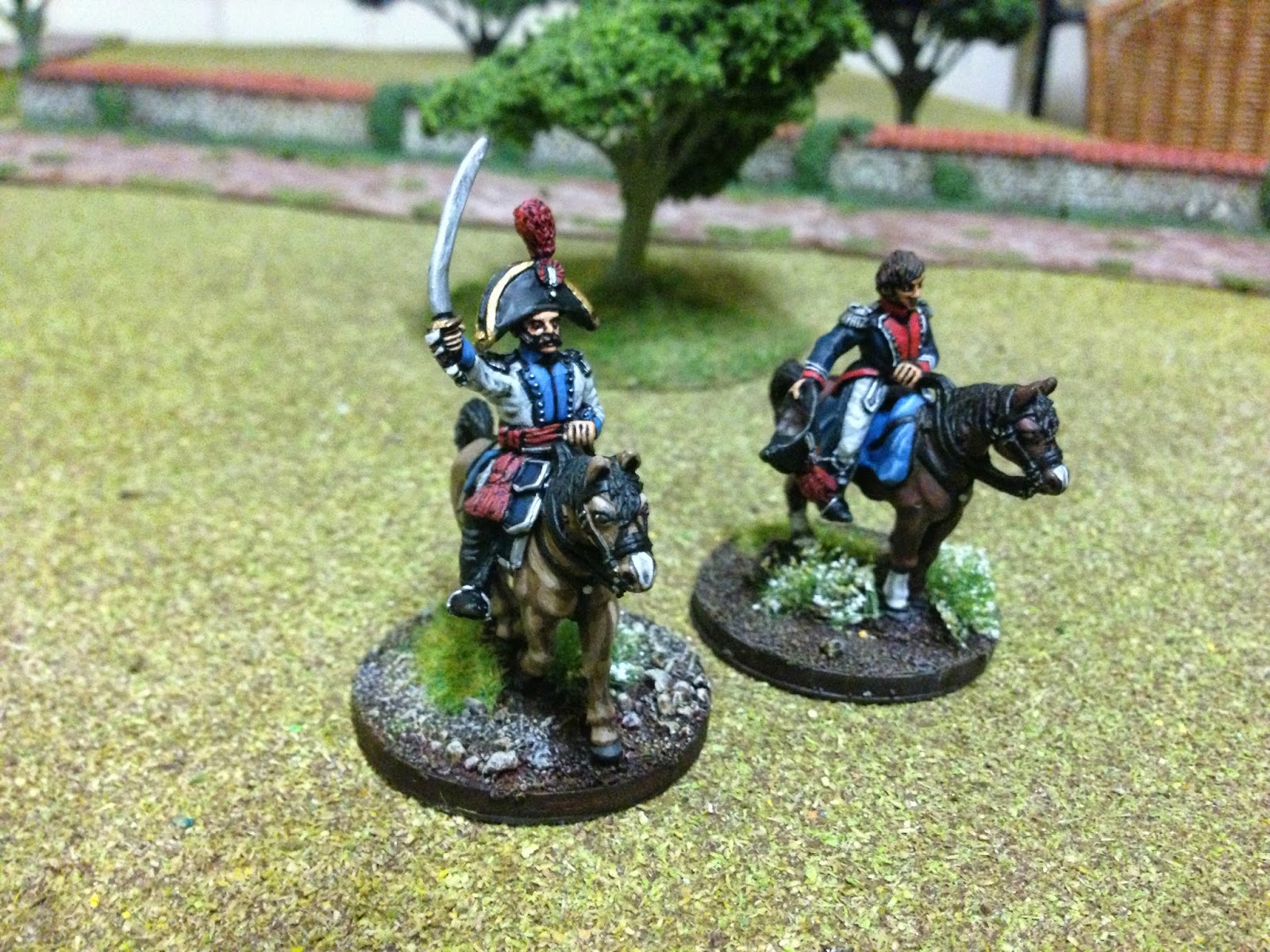
I am probably a little less happy with the way figure on the left (below) turned out however, in that I accidentally used some very Christmassy-looking colours. I started to give him gold lace, but it began to feel too much like adding tinsel to a Christmas tree so I ended up giving him plain white piping:
That said, I found it rather amusing to position him in such a way as to appear that he is trying to ignore the orders being handed to him by the ADC. Unfortunately, Front Rank don't have a Spanish officer figure which is looking toward their left, so it was inevitable I suppose...
That's my Spanish 28mm project completed. I'll probably try to put together one final post on these as a fully assembled army (before I move on to some 15mm Portuguese) - mainly for my own amusement but also, hopefully, that of others who may be interested.
Wednesday, 23 April 2014
Friday, 11 April 2014
Spanish Artillery
I am a big fan of Front Rank, and these are the first of their artillery models that I have managed to complete. They were a lot of fun,not only due to the detail but also the lack of flash in areas such as wheel spokes which has annoyed me with some other manufacturers in the past, so preparation was particularly easy.
I tried hard to find a colour for the artillery pieces themselves that I was happy with. Some sources suggested that Spanish artillery should be grey, and I have read others that indicate that the paint they used was cobalt-based (thank you Stephen Summerfield), and should therefore have been more of a blueish tinge which may ultimately fade to grey with continued exposure to sunlight.
In the end I settled for the Foundry British blue-grey triad, which probably suggests Spanish artillery that has recently rolled off the production line, but I am reasonably happy with the result.
The main thing I did have some doubt over was the base size. I am aware that if a crew was to try to fire a gun in these positions, most of them would end up concussed or permanently maimed, and was tempted to put them on 60mm x 80mm bases to provide a bit more scope for positioning and to create more of a mini-diorama appearence. That said, I decided to stick with my 60mm x 40mm convention to keep them consistent with my old Minifigs and Hinchcliffe armies, but it really served to underline to me how much figures have "grown" over the years.
My particular basing issues aside, if anyone else is looking to put together Napoleonic Spanish artillery, I can thoroughly recommend the Front Rank models for consideration.
I tried hard to find a colour for the artillery pieces themselves that I was happy with. Some sources suggested that Spanish artillery should be grey, and I have read others that indicate that the paint they used was cobalt-based (thank you Stephen Summerfield), and should therefore have been more of a blueish tinge which may ultimately fade to grey with continued exposure to sunlight.
In the end I settled for the Foundry British blue-grey triad, which probably suggests Spanish artillery that has recently rolled off the production line, but I am reasonably happy with the result.
The main thing I did have some doubt over was the base size. I am aware that if a crew was to try to fire a gun in these positions, most of them would end up concussed or permanently maimed, and was tempted to put them on 60mm x 80mm bases to provide a bit more scope for positioning and to create more of a mini-diorama appearence. That said, I decided to stick with my 60mm x 40mm convention to keep them consistent with my old Minifigs and Hinchcliffe armies, but it really served to underline to me how much figures have "grown" over the years.
My particular basing issues aside, if anyone else is looking to put together Napoleonic Spanish artillery, I can thoroughly recommend the Front Rank models for consideration.
Monday, 3 March 2014
Spanish Guerrillas
I managed to complete a battalion pack's worth of the Front Rank Spanish guerrillas over the past couple of weeks, comprising twenty-four figures in all. I am not quite sure when I will get to use them alongside my Spanish regulars, but they form such an iconic part of the Spanish resistance against the French that I felt the army would be incomplete without them.
The majority have been based singly anyway, with the vague notion that I might want to use them for skirmish gaming at some stage as well. I have a copy of Sharp Practice from Too Fat Lardies, and will probably base some 95th Rifles and French Voltigeurs the same way, to round things out.
There is a fair bit of variety in the pack, including a few that probably wouldn't look out of place as pirates.
:
I made a conscious effort to try not to go too overboard with colour, and stuck mainly to rustic-looking browns for the majority in an effort to make them look more like peasant clothing. I did allow myself a bit more license with some of the blankets they were carrying however, in order to lighten things up a little:
All things considered, with the combination of poses and variety of clothing and equipment, these were fun to paint.
The majority have been based singly anyway, with the vague notion that I might want to use them for skirmish gaming at some stage as well. I have a copy of Sharp Practice from Too Fat Lardies, and will probably base some 95th Rifles and French Voltigeurs the same way, to round things out.
There is a fair bit of variety in the pack, including a few that probably wouldn't look out of place as pirates.
:
I made a conscious effort to try not to go too overboard with colour, and stuck mainly to rustic-looking browns for the majority in an effort to make them look more like peasant clothing. I did allow myself a bit more license with some of the blankets they were carrying however, in order to lighten things up a little:
All things considered, with the combination of poses and variety of clothing and equipment, these were fun to paint.
Wednesday, 5 February 2014
Spanish Militia
It felt a bit strange going back to Front Rank after a few battalions of Eagle miniatures, as the figures are arguably at opposite ends of the 28mm spectrum and these Front Rank definitely feel quite hefty in comparison.
I was also a bit wary about brown as a theme as well, but half-way through I was really starting to enjoy the experience and reminded myself how much I love the Front Rank style.
The first of these is my interpretation of a couple of the tercios of the Catalonia militia:
While these figures were most likely initially intended for use as regulars for the Spanish army of 1811 and thereafter, I think they work quite well as urban militia:
I have relied upon the dependable Rene Chartrand and his second Osprey to try and interpret the uniform for these:
The second couple of units are based upon Chartrand's description of the Galicia militia, and I think the yellow facings work quite well with the brown uniforms:
The top hats and brown uniforms remind me a little of Victorian chimney sweeps, but they make a nice contrast to the rest of the Spanish:
The flags are GMB, and in this case I have used some from the Voluntarios de Barcelona. Not strictly a militia unit, and the flags could more probably have been home-grown rather than standard issue, but I decided to use these in case I wish to double them up as brown-uniformed regulars at some stage.
I was also a bit wary about brown as a theme as well, but half-way through I was really starting to enjoy the experience and reminded myself how much I love the Front Rank style.
The first of these is my interpretation of a couple of the tercios of the Catalonia militia:
While these figures were most likely initially intended for use as regulars for the Spanish army of 1811 and thereafter, I think they work quite well as urban militia:
I have relied upon the dependable Rene Chartrand and his second Osprey to try and interpret the uniform for these:
The second couple of units are based upon Chartrand's description of the Galicia militia, and I think the yellow facings work quite well with the brown uniforms:
The top hats and brown uniforms remind me a little of Victorian chimney sweeps, but they make a nice contrast to the rest of the Spanish:
The flags are GMB, and in this case I have used some from the Voluntarios de Barcelona. Not strictly a militia unit, and the flags could more probably have been home-grown rather than standard issue, but I decided to use these in case I wish to double them up as brown-uniformed regulars at some stage.
Thursday, 9 January 2014
Walloon Guards
The Walloon Guards, or Guardias de Infanteria Walonna, are the last of my projected Spanish regular units and one of my favourites. Originally raised in 1704 from the area of what is now Belgium at a time when that region was under the Spanish Crown, they were assimilated into the royal household alongside the then recently established Spanish Guards. I went with Eagle Miniatures for these figures which, like their Swiss, have the longer tails on the coats but also have the paired buttonhole lace which was apparently a distinctive feature of the regiment's uniform:
The only downside is that there aren't any matching grenadiers available, but the figures themselves are nicely detailed if a lot slighter than my usual Front Rank:
The flags are by Adolfo Ramos which I think look great and are well and truly up there with GMB's, although I have found that they are a little more absorbent and one has to ensure that they are lined up first time as they don't "slide" around as much as what I am used to with the GMB designs:
Now it's back to Front Rank, and the four militia battalions which I am hoping to have completed by the end of the month.
Monday, 23 December 2013
Swiss in Spanish Service
I have managed to complete three more battalions for my Spanish project, representing three of the Swiss regiments in Spanish service at the time of the French invasion in 1808. The three battalions are from the Preux, Reding and Betschart regiments:
They distinguished themselves at Bailen, even coming up against fellow Swiss who had been pressed into service as part of Dupont's army, which caused the latter to defect from the French back to the Spanish side:
The rather distinctive-looking Swiss flags are from Adolfo Ramos in Spain, and I think they really serve to give the units a unique appearance:
The Eagle figures are quite nicely detailed, although they are a lot slimmer than my usual Front Rank and would not mix well in the same unit. They are around the same height however, and to my eye do not look out of place as a separate unit:
They distinguished themselves at Bailen, even coming up against fellow Swiss who had been pressed into service as part of Dupont's army, which caused the latter to defect from the French back to the Spanish side:
The figures are from Eagle Miniatures, and represent quite well the longer tails of the Swiss coats. Unfortunately there were no grenadier figures available, so I decided to pad the units out with fusiliers:
The rather distinctive-looking Swiss flags are from Adolfo Ramos in Spain, and I think they really serve to give the units a unique appearance:
The Eagle figures are quite nicely detailed, although they are a lot slimmer than my usual Front Rank and would not mix well in the same unit. They are around the same height however, and to my eye do not look out of place as a separate unit:
Friday, 25 October 2013
Garrochistas
Another unit which doesn't really fit in with my Talavera project, but one which I felt compelled to purchase. This unit of irregulars were composed of Spanish cattle herders, and distinguished themselves at Bailen:
The Front Rank figures certainly look the part, with the characteristic "Franciscan" straw hat:
I also replaced the standard Front Rank lance with some from North Star, which I think look a bit more in line with the Spanish "garrocha":
There were apparently between two to five hundred of them there, so a dozen figures at a ratio of 1:40 is probably at the higher end, but at least they provide something a little different:
The Front Rank figures certainly look the part, with the characteristic "Franciscan" straw hat:
I also replaced the standard Front Rank lance with some from North Star, which I think look a bit more in line with the Spanish "garrocha":
There were apparently between two to five hundred of them there, so a dozen figures at a ratio of 1:40 is probably at the higher end, but at least they provide something a little different:
Subscribe to:
Posts (Atom)