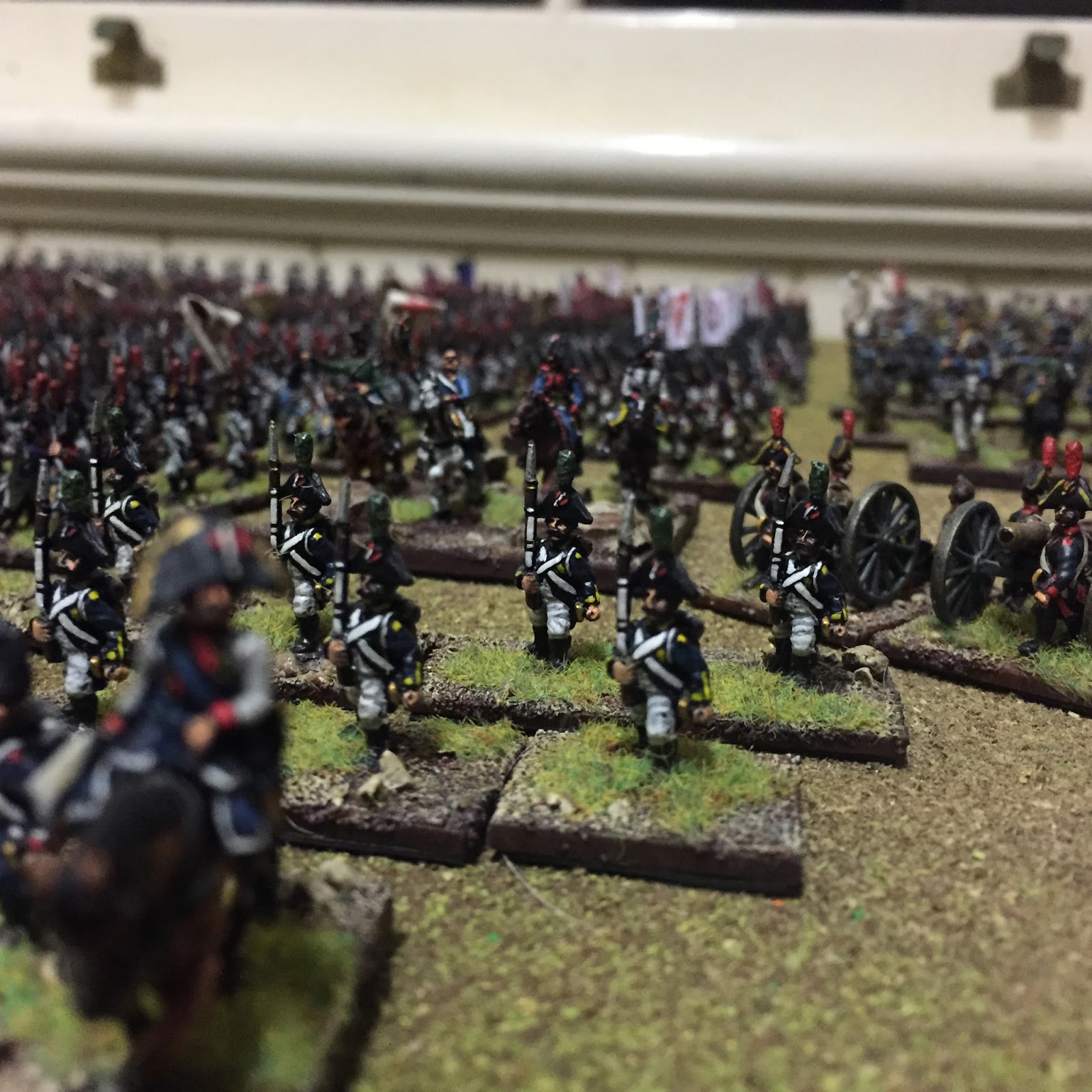
I was a little worried about painting this regiment as, being part of the Portuguese Northern Division, it has yellow piping:
(along with the yellow regimental flag carried by the second battalion):
This is because I have not yet found a yellow that I am completely happy with. I usually use the Foundry triad sets for most of my figures, and their yellow is not a problem if there is a large area to be block painted as it is quite easy to build up a fairly solid yellow with successive coats, but I wasn't looking forward to potentially having to go over the piping four times to obtain a bit of depth. In the end I managed to get away with a brown undercoat and a single layer of GW Yellow for most of it, with an additional layer on the more exposed or highlighted bits:
The 3rd Regiment were pretty much a constant throughout the Peninsular War and were in Spry's brigade at the key battles of Fuentes d'Onoro, Salamanca and Vittoria. Again, I chose to do the bulk of the figures in the white summer campaign trousers, rather than the dark blue regulation or winter issue:
That is eight line battalions completed to date, with another ten from a further five regiments to go.
Saturday, 18 July 2015
Tuesday, 30 June 2015
Spanish Line
The last set of units, these nineteen battalions of Spanish line had been awaiting some updated flags and their unit labels for each of the command stand, which I finally managed to complete the weekend before last:
Each battalion consists of twenty-four figures, on a ratio of roughly 1:40. They have just one company of grenadiers however, which is slightly different to my 28mm version of the same army where I painted half the figures of the first battalion of each regiment as grenadiers, but none for any second battalion of the same regiment (where they existed):
This is again due to the order of battle for the Spanish of the 15mm group I game with, and an argument can be lodged for either case particularly as the Spanish, as with the Austrians and Russians, were often in the habit of removing grenadiers from line units to form converged grenadier battalions, of which I have also completed half a dozen in this particular army and photographed on an earlier post.
For the line battalions I tried to use an assortment of differing facing colours to provide some variety, the only slightly disappointing aspect being that the lapels are largely obscured by the cross-belts on the 15mm Essex figures:
That said, I found the Essex figures quite nice to paint, although doing so many of the same pose did become a little monotonous after a while:
The battalions consist of one each from the following regiments: Rey; Reina; Princesa; Principe; Granada; Guadalajara; Ordonnes, Cantabria; Navarra; Valencia; Aragon; Malaga; Leon; America; Zaragoza; Mallorca; Espait; Cordoba and Murcia, some famous names and also some great holiday spots amongst these.
In terms of the flags and given that many of the actual regiments only consisted of only one battalion, I could have provided some of the regiments with both the Coronela and Ordenanza standards, but was ultimately limited by the number of flag bearers in the Essex command packs, and also by our basing convention which allows only three figures to a base for Spanish line. In the end I distributed them between the units on a roughly 50/50 basis, again to give a little more variety.
Now that they are completed, I might try to haul the entire army out for a group photo before they get stored away, then to no doubt be dispatched piecemeal for various games in the future.
Each battalion consists of twenty-four figures, on a ratio of roughly 1:40. They have just one company of grenadiers however, which is slightly different to my 28mm version of the same army where I painted half the figures of the first battalion of each regiment as grenadiers, but none for any second battalion of the same regiment (where they existed):
This is again due to the order of battle for the Spanish of the 15mm group I game with, and an argument can be lodged for either case particularly as the Spanish, as with the Austrians and Russians, were often in the habit of removing grenadiers from line units to form converged grenadier battalions, of which I have also completed half a dozen in this particular army and photographed on an earlier post.
For the line battalions I tried to use an assortment of differing facing colours to provide some variety, the only slightly disappointing aspect being that the lapels are largely obscured by the cross-belts on the 15mm Essex figures:
That said, I found the Essex figures quite nice to paint, although doing so many of the same pose did become a little monotonous after a while:
The battalions consist of one each from the following regiments: Rey; Reina; Princesa; Principe; Granada; Guadalajara; Ordonnes, Cantabria; Navarra; Valencia; Aragon; Malaga; Leon; America; Zaragoza; Mallorca; Espait; Cordoba and Murcia, some famous names and also some great holiday spots amongst these.
In terms of the flags and given that many of the actual regiments only consisted of only one battalion, I could have provided some of the regiments with both the Coronela and Ordenanza standards, but was ultimately limited by the number of flag bearers in the Essex command packs, and also by our basing convention which allows only three figures to a base for Spanish line. In the end I distributed them between the units on a roughly 50/50 basis, again to give a little more variety.
Now that they are completed, I might try to haul the entire army out for a group photo before they get stored away, then to no doubt be dispatched piecemeal for various games in the future.
Monday, 29 June 2015
Spanish 15mm Army
Even though the bulk of it was completed two years or so ago, I have only in the past month put the finishing touches on this Spanish 15mm Napoleonic army to the point where I can now consider it complete.
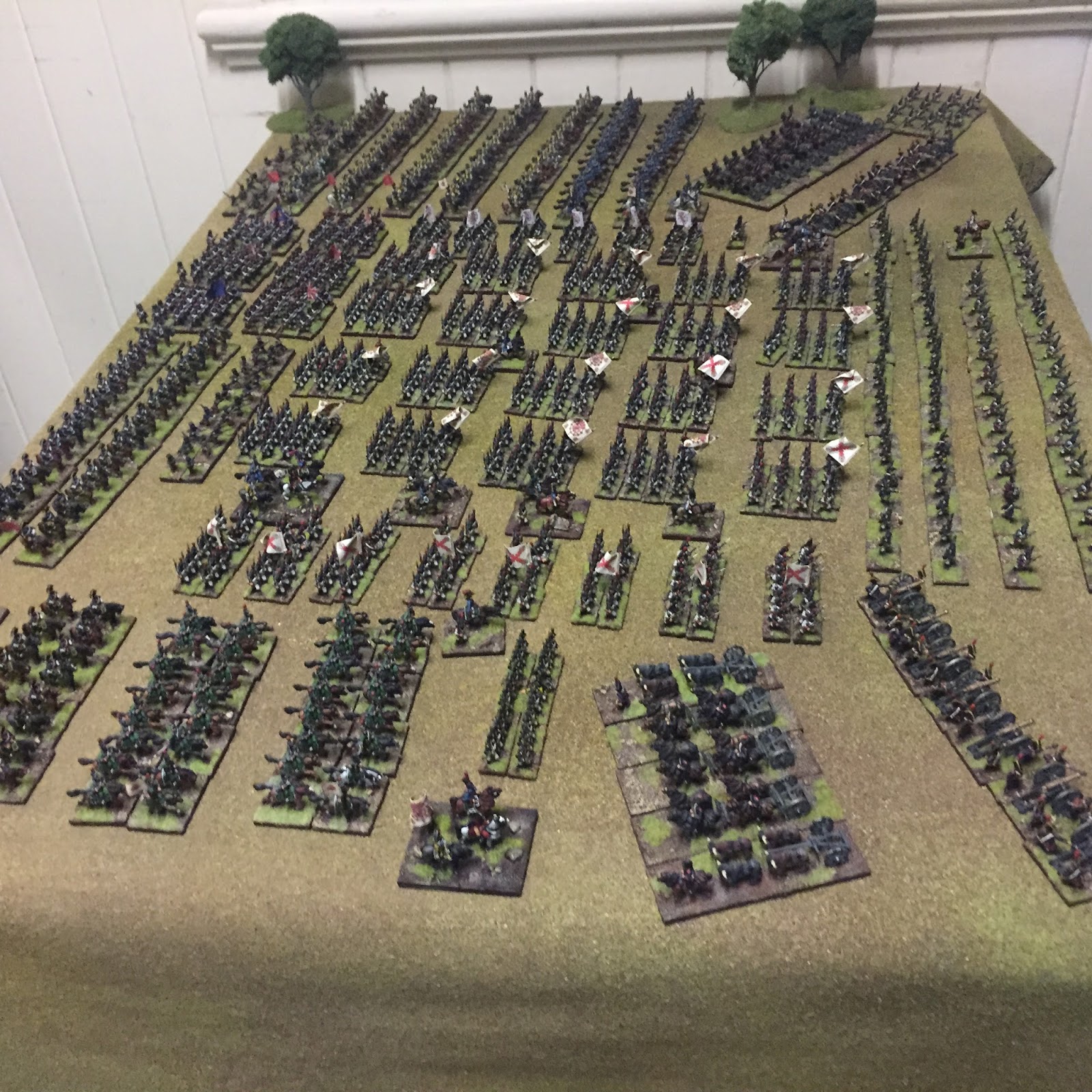
It is probably self-indulgent but, as I probably won't get the chance to assemble it again in its entirety, I thought I would set it up for a a few group photos, if nothing else than to remind me what I actually had actually managed to assemble.
Firstly, a view of the army from the front:
And another view of the same from the flank:
The figures are all Essex Miniatures 15mm, apart from the staff figures which are from Warmodelling who have an excellent range of Spanish personality figures covering most of the Peninsular war.
Here is a shot of the Warmodelling General Jose Pascual de Zayas figure in front of some light cavalry, who was one of the most ably performed of the Spanish Generals and performed so creditably at Albuera (primarily because he had taken the time to put his troops through several weeks' worth of manoeuvres prior to the battle):
All of the flags are GMB, with the exception of those of the Spanish Guard and Swiss which I again purchased from Adolfo Ramos in Spain:
The flag of the Guardias Royale in particular is amongst my favourite Napoleonic flags as it is quite distinctive:
Twelve regiments of cavalry in all, including five of the yellow-coated dragoons seen here from the back, with a unit of guerrillas at their rear (which I am not sure I would be completely comfortable with):
Here they are again from the front, with two hussar regiments and a line of artillery spread before them:
I managed fourteen artillery pieces in all, with the number of figures representing how many pieces there are in each battery, with either three or four crew figures on each base:
I attempted to add a bit of variety to the limbers by including a few ox-drawn pieces, to represent the difficulty the Spanish had in finding decent horseflesh. Notwithstanding that, the Spanish artillery was one of their best-performing arms:
Also included are six units of light infantry to provide the army with a decent skirmish screen, seen here spread across the front:
And with the also very able General Don Pedro Caro y Sureda, 3rd Marquis de Romana, and his staff visible in the background:
The one nice surprise I found when putting together both this and its larger 28mm couterpart was how much colour and variety is to be found in a Spanish Napoleonic army, particularly that of the earlier part of the war before the rather more drab British supplies found their way through as replacements. Some of that may be seen in the following overhead shot, which includes elements of the line, converged grenadier battalions, the Swiss, the Guard, an Irish battalion, along with some hussars, dragoons and heavy calavlry:
In case anyone is interested (and to help my own failing memory), the final numbers for the army is as follows:
23 line battalions of 24 figures each
3 Guard battalions of 25 figures each
6 composite Grenadier battalions of 12 figures each
8 provincial militia battalions of 15 figures each
1 urban militia battalion of 20 figures
4 light battalions of 20 figures each
2 light battalions of 16 figures each
1 band of guerrillas of 20 figures
14 artillery pieces with 48 crew
12 limbers with 20 figures and 50 horses and oxen
5 dragoon regiments of 16 figures each
3 heavy cavalry regiments of 16 figures each
4 light and hussar regiments of 16 figures each
25 mounted and 9 foot staff figures
This gives a total of 1,265 figures along with 267 horses.
Probably more than I will ever need, but hopefully enough variation to cover most scenarios:
Now to complete my 28mm Portuguese project, which I am optimistic enough to believe might be achieved before the end of the year.
It is probably self-indulgent but, as I probably won't get the chance to assemble it again in its entirety, I thought I would set it up for a a few group photos, if nothing else than to remind me what I actually had actually managed to assemble.
Firstly, a view of the army from the front:
And another view of the same from the flank:
The figures are all Essex Miniatures 15mm, apart from the staff figures which are from Warmodelling who have an excellent range of Spanish personality figures covering most of the Peninsular war.
Here is a shot of the Warmodelling General Jose Pascual de Zayas figure in front of some light cavalry, who was one of the most ably performed of the Spanish Generals and performed so creditably at Albuera (primarily because he had taken the time to put his troops through several weeks' worth of manoeuvres prior to the battle):
All of the flags are GMB, with the exception of those of the Spanish Guard and Swiss which I again purchased from Adolfo Ramos in Spain:
The flag of the Guardias Royale in particular is amongst my favourite Napoleonic flags as it is quite distinctive:
Twelve regiments of cavalry in all, including five of the yellow-coated dragoons seen here from the back, with a unit of guerrillas at their rear (which I am not sure I would be completely comfortable with):
Here they are again from the front, with two hussar regiments and a line of artillery spread before them:
I managed fourteen artillery pieces in all, with the number of figures representing how many pieces there are in each battery, with either three or four crew figures on each base:
I attempted to add a bit of variety to the limbers by including a few ox-drawn pieces, to represent the difficulty the Spanish had in finding decent horseflesh. Notwithstanding that, the Spanish artillery was one of their best-performing arms:
Also included are six units of light infantry to provide the army with a decent skirmish screen, seen here spread across the front:
And with the also very able General Don Pedro Caro y Sureda, 3rd Marquis de Romana, and his staff visible in the background:
The one nice surprise I found when putting together both this and its larger 28mm couterpart was how much colour and variety is to be found in a Spanish Napoleonic army, particularly that of the earlier part of the war before the rather more drab British supplies found their way through as replacements. Some of that may be seen in the following overhead shot, which includes elements of the line, converged grenadier battalions, the Swiss, the Guard, an Irish battalion, along with some hussars, dragoons and heavy calavlry:
In case anyone is interested (and to help my own failing memory), the final numbers for the army is as follows:
23 line battalions of 24 figures each
3 Guard battalions of 25 figures each
6 composite Grenadier battalions of 12 figures each
8 provincial militia battalions of 15 figures each
1 urban militia battalion of 20 figures
4 light battalions of 20 figures each
2 light battalions of 16 figures each
1 band of guerrillas of 20 figures
14 artillery pieces with 48 crew
12 limbers with 20 figures and 50 horses and oxen
5 dragoon regiments of 16 figures each
3 heavy cavalry regiments of 16 figures each
4 light and hussar regiments of 16 figures each
25 mounted and 9 foot staff figures
This gives a total of 1,265 figures along with 267 horses.
Probably more than I will ever need, but hopefully enough variation to cover most scenarios:
Now to complete my 28mm Portuguese project, which I am optimistic enough to believe might be achieved before the end of the year.
Saturday, 27 June 2015
Spanish Provincial Militia
Over the past couple of weeks I have finally managed to put the finishing touches on the Provincial Militia and Line for my Spanish 15mm army. The figures themselves had actually been completed over a year ago and a few units have seen action on the table, but the line and militia have been awaiting their flags and the labels for their bases, indicating their unit designations.
I put together eight units of Provincial militia, which are essentially the Essex Spanish line figures painted with the red facings and brass buttons of the 1805 militia uniform issue:
This is in contrast to the Urban Militia units which were more mixed in appearance, and for which I used a mixture of browns to represent more hastily acquired clothing as opposed to a regulation uniform.
The militia were present in a number of engagements where it has to be said they performed poorly. At Talavera anywhere up to four battalions were said to have fled at the sound of their own gunfire as the front ranks engaged a few skirmishing French cavalry, much to the bemusement of the British (and annoyance when they were found to have apparently looted the baggage train after their departure). It has to be questioned whether this is really very surprising as they were poorly trained, led and supplied, and it is probably a sign of their fortitude that they were there in the first place.
In the rules our group games with they are classed an 'E' and we have to be extremely careful where we place them, which is normally to the rear where they act as a morale bonus in providing rear support:
The paper strength for Spanish militia units does appear to indicate a number of attached grenadier companies. Nafziger however appears to dispute this so we have not included them in our order of battle for the Spanish. That said, I threw a few in and painted a couple of figures in blue overcoats, for the sake of variety:
That's the militia completed, and I have finalised nineteen battalions of the line which I also hope to photograph for the sake of posterity over the next few days.
I put together eight units of Provincial militia, which are essentially the Essex Spanish line figures painted with the red facings and brass buttons of the 1805 militia uniform issue:
This is in contrast to the Urban Militia units which were more mixed in appearance, and for which I used a mixture of browns to represent more hastily acquired clothing as opposed to a regulation uniform.
The militia were present in a number of engagements where it has to be said they performed poorly. At Talavera anywhere up to four battalions were said to have fled at the sound of their own gunfire as the front ranks engaged a few skirmishing French cavalry, much to the bemusement of the British (and annoyance when they were found to have apparently looted the baggage train after their departure). It has to be questioned whether this is really very surprising as they were poorly trained, led and supplied, and it is probably a sign of their fortitude that they were there in the first place.
In the rules our group games with they are classed an 'E' and we have to be extremely careful where we place them, which is normally to the rear where they act as a morale bonus in providing rear support:
The paper strength for Spanish militia units does appear to indicate a number of attached grenadier companies. Nafziger however appears to dispute this so we have not included them in our order of battle for the Spanish. That said, I threw a few in and painted a couple of figures in blue overcoats, for the sake of variety:
That's the militia completed, and I have finalised nineteen battalions of the line which I also hope to photograph for the sake of posterity over the next few days.
Wednesday, 17 June 2015
Portuguese 4th Freire Regiment
It feels a little disingenuous to be putting up a post on Napoleonic Portuguese when it is currently the 18th of June here in Australia. I do now wish that I had done something a little more special to mark the 200th anniversary of Waterloo as many others have done, but then I completed these on the weekend and am now knee-deep in this particular project. Besides, I have been thoroughly enjoying reading the lead-up to the battle on people's blogs elsewhere, and especially the spectacular campaign and battle recreations.
To be honest, Waterloo is starting to represent something a little akin to Brigadoon or the end of the rainbow to me, in that I have been to Belgium twice including Brussels itself on one occasion, but simply ran out of time (family commitments and small children etc.), and then went on a driving holiday through France with the express intent of heading up to the battlefield toward the end of the holiday, only to have the car blow a head gasket which meant we had to spend the whole ten days in Paris (no real hardship, it has to be said).
To top it off, I was booked on a battlefield tour for the celebrations this year, but ended up having to cancel due to other commitments. At least I can live my life vicariously through the internet until I can launch a fifth attempt, hopefully at some point in the next couple of years.
Anyway, they may not be French, Prussian, British etc., but at least they are Napoleonic. Another couple of Portuguese battalions completed in the form of the 4th Freire regiment, which is a regiment that formed part of the Centre Division as indicated by the white regimental flag carried by the second battalion, and by their white piping:
This regiment saw action at Albuera as part of Hamilton's Portuguese brigade, but were probably wearing the stovepipe by then. However, since I am aiming toward an earlier Portuguese army, I have again painted them using the Front Rank barretina-wearing figures (which I have to say I prefer anyway as it has always seemed to me to be one of the defining characteristics of the Portuguese uniform):

As with the previously completed battalions, I have used Front Rank flag finials with the tassels and done these in line with the Divisional colours, in this case white:
I have also painted the bulk of the figures in the regulation or dark blue pantaloons, as opposed to the white issued for the summer campaign season, mainly to give a bit of variety and because I was becoming a little bored with the similarity between the units:
That's three regiments comprised of six battalions now completed, and I have the two battalions of the 3rd/1st Olivenza regiment on the painting table at the moment, which should see me through to the end of the month at least.
To be honest, Waterloo is starting to represent something a little akin to Brigadoon or the end of the rainbow to me, in that I have been to Belgium twice including Brussels itself on one occasion, but simply ran out of time (family commitments and small children etc.), and then went on a driving holiday through France with the express intent of heading up to the battlefield toward the end of the holiday, only to have the car blow a head gasket which meant we had to spend the whole ten days in Paris (no real hardship, it has to be said).
To top it off, I was booked on a battlefield tour for the celebrations this year, but ended up having to cancel due to other commitments. At least I can live my life vicariously through the internet until I can launch a fifth attempt, hopefully at some point in the next couple of years.
Anyway, they may not be French, Prussian, British etc., but at least they are Napoleonic. Another couple of Portuguese battalions completed in the form of the 4th Freire regiment, which is a regiment that formed part of the Centre Division as indicated by the white regimental flag carried by the second battalion, and by their white piping:
This regiment saw action at Albuera as part of Hamilton's Portuguese brigade, but were probably wearing the stovepipe by then. However, since I am aiming toward an earlier Portuguese army, I have again painted them using the Front Rank barretina-wearing figures (which I have to say I prefer anyway as it has always seemed to me to be one of the defining characteristics of the Portuguese uniform):
As with the previously completed battalions, I have used Front Rank flag finials with the tassels and done these in line with the Divisional colours, in this case white:
I have also painted the bulk of the figures in the regulation or dark blue pantaloons, as opposed to the white issued for the summer campaign season, mainly to give a bit of variety and because I was becoming a little bored with the similarity between the units:
That's three regiments comprised of six battalions now completed, and I have the two battalions of the 3rd/1st Olivenza regiment on the painting table at the moment, which should see me through to the end of the month at least.
Sunday, 17 May 2015
Portuguese 2nd Lagos Regiment
Another two battalions completed toward a 28mm Portuguese project, and this time the 2nd Lagos Regiment.
Belonging to the Southern Grand Division, the Lagos regiment's uniforms were therefore piped in red with turnbacks of the same colours, and the second battalion carried a red regimental colour:
The 2nd Lagos were usually brigaded with the 14th Tavira regiment, both having been raised from the Algarve region of Portugal, and was present at Bussaco, Albuera, Vittoria and the push into Southern France in 1814.
Here is the first battalion carrying the King's colour:
And the second with the regimental flag:
Finally, a quick look at the second from the rear, which is a view I don't believe the French ever saw, and one I hope won't occur too often when this regiment eventually takes to the table:
I have just ordered a few more flags from GMB to complete a regiment or two from the Northern Division.
I do have to keep reminding myself to paint in the regimental numbers on these flags which Grahame Black has thoughtfully left blank, the Arabic number generally being the only difference between flags of the same division.
I just wish I could remember to paint them when they are lying flat, rather than after I have attached and curled them around the flag staves...
Belonging to the Southern Grand Division, the Lagos regiment's uniforms were therefore piped in red with turnbacks of the same colours, and the second battalion carried a red regimental colour:
The 2nd Lagos were usually brigaded with the 14th Tavira regiment, both having been raised from the Algarve region of Portugal, and was present at Bussaco, Albuera, Vittoria and the push into Southern France in 1814.
Here is the first battalion carrying the King's colour:
And the second with the regimental flag:
Finally, a quick look at the second from the rear, which is a view I don't believe the French ever saw, and one I hope won't occur too often when this regiment eventually takes to the table:
I have just ordered a few more flags from GMB to complete a regiment or two from the Northern Division.
I do have to keep reminding myself to paint in the regimental numbers on these flags which Grahame Black has thoughtfully left blank, the Arabic number generally being the only difference between flags of the same division.
I just wish I could remember to paint them when they are lying flat, rather than after I have attached and curled them around the flag staves...
Tuesday, 28 April 2015
Portuguese 1st Lippe Regiment
It is nice to start a new project, even when it is just a larger version of the previous one. I am quite happy to get back to 28mm, but it took me the best part of a week to adjust to picking up the 28mm Front Rank figures which look and feel massive compared to the 15mm Essex Portuguese I have spent the best part of the last eight months painting.
I intend to follow roughly the same track with these, especially as the uniform details are still somewhat fresh in my mind. To this end, I managed to complete the two battalions of the 1st Lippe Regiment over the previous weekend.
And the second with the Regimental Colour, which is white in this case in line with the regiment's white piping and turnbacks, indicating a unit of the Center Division:
Portuguese flags typically had a brass finial with a cravat or ribbon, but I have used the Front Rank flag staff finial with a tassel and painted it in line with the unit's division. I have seen a few conflicting images, with some suggesting the cravat should be red, white and blue and others that it should be white and blue, but I went with the divisional colour as any other combination would to my mind have looked a bit odd with the rope and tassels. I managed to find a couple of images to substantiate this, so that is good enough for me:
I have done the majority of the figures in the white summer trousers on the basis that this was when most of the campaigning was done but threw in a few, such as the grenadiers below, with the regulation blue issue:
These battalions are possibly overly large given the returns I have read in Oman and the rough 1:30/1:40 ratio I am ostensibly working to, but possibly it is better to paint too many figures and take a few away in any potential future games, rather than not having enough.
Now on to the 2nd Lagos, with the red piping and turnbacks of the Southern Division which I suspect I will have to again go over twice with two different shades to obtain a visible contrast against the blue jackets.
I find piping the most tedious but at the same time most satisfying aspect of Napoleonic figures, but am definitely not looking forward to the yellow of the Northern Division.
I intend to follow roughly the same track with these, especially as the uniform details are still somewhat fresh in my mind. To this end, I managed to complete the two battalions of the 1st Lippe Regiment over the previous weekend.
Portuguese line regiments typically consisted of two battalions which were deployed alongside each other in the same brigade, with the brigade usually comprised of four battalions from two regiments (occasionally with a Cacadore battalion included to make five battalions in all, such as Spry's brigade at Fuentes de Onoro), or one regiment and a Cacadore battalion. Here is the first battalion of 1st Lippe carrying the King's Colour:
And the second with the Regimental Colour, which is white in this case in line with the regiment's white piping and turnbacks, indicating a unit of the Center Division:
Portuguese flags typically had a brass finial with a cravat or ribbon, but I have used the Front Rank flag staff finial with a tassel and painted it in line with the unit's division. I have seen a few conflicting images, with some suggesting the cravat should be red, white and blue and others that it should be white and blue, but I went with the divisional colour as any other combination would to my mind have looked a bit odd with the rope and tassels. I managed to find a couple of images to substantiate this, so that is good enough for me:
I have done the majority of the figures in the white summer trousers on the basis that this was when most of the campaigning was done but threw in a few, such as the grenadiers below, with the regulation blue issue:
These battalions are possibly overly large given the returns I have read in Oman and the rough 1:30/1:40 ratio I am ostensibly working to, but possibly it is better to paint too many figures and take a few away in any potential future games, rather than not having enough.
Now on to the 2nd Lagos, with the red piping and turnbacks of the Southern Division which I suspect I will have to again go over twice with two different shades to obtain a visible contrast against the blue jackets.
I find piping the most tedious but at the same time most satisfying aspect of Napoleonic figures, but am definitely not looking forward to the yellow of the Northern Division.
Subscribe to:
Posts (Atom)