While waiting for the arrival of some chariot riders to complete my Gallic army, I thought I'd embark upon another project in the queue and make a start on a 15mm ancient Spanish army. The first unit completed is comprised of ten elements of Spanish scutarii:
The figures are again Xyston miniatures, and are based in elements of three figures each:
The Xyston packs are of eight figures each, normally four with swords and another four with javelins, so I decided to keep the blades together and will base the javelin-armed figures on separate bases. I am hoping this will give me more flexibility between the DBMM Iberian and Celtiberian Spanish army lists:
The shield designs are again by Little Big Men studios, and I think they have quite a nice Spanish look to them:
I have mainly used different browns for these figures, with the occasional white and off-white tunic thrown in, to give them a more subdued look:
I was also intending to do the bases with more of an arid theme, along the lines of the Ottoman Turks completed last year, but remembered that some of these units will be fighting alongside the Gauls in several army lists and thought that different base styles in the same army may end up looking a bit odd on the table:
The unit also contains the first of six command stands, and I should be able to field around sixty elements of scutarii when completed:
We actually managed a dry-run of DBMM 3.1 today with a throw-away game pitting Babylonians against Macedonians. This was my first Ancients game since WRG Version 6, but luckily the guys I am playing with are all conversant with earlier versions of DBMM.
It still took four of us to get our heads around the rules but I found them quite enjoyable, although my hope is that we will also be able to give 'To The Strongest' a run-through in the near future.
I am hoping to complete the chariots over the following week, followed by four additional elements of Gallic cavalry which will then see the end of that project. I'll probably then try to do another couple of units of Spanish, although there are some Napoleonic French cuirassiers that have been patiently sitting atop the work desk for a year now and which I really should complete before I start losing figures.
Saturday, 2 February 2019
Tuesday, 22 January 2019
Gaesatae
The penultimate block of troops for this project, the Gaesatae were apparently not a tribe as I originally believed but more a group of warriors who lived in the Southern Alps and probably hired themselves out as mercenaries. The term 'gaesatae' appears therefore to refer to many of them being armed with a spear, rather than any tribal nomenclature:
I have completed 101 figures in all, with 99 of them based here across 33 elements of three figures each, and two left over for basing with the dozen chariots I have left to complete:
They are depicted, as Gaesatae usually are, without clothing. This is following the battle of Telamon in 225 BC where they collectively decided to throw off their clothes and charge naked at the Romans:
This was apparently to throw fear into the Romans, and Polybius states there may have also been a practical reason in that they didn't want to get their clothes caught in the brambles that were growing on the slopes of the hill atop which the Romans were positioned.
Either way, it probably seemed like a good idea at the time and appears to have been pretty much a one-off. It did make painting them a lot easier than the rest of the Gallic army, although they still required four layers including a wash for the flesh-tone:
With the command and standard-bearer figures there are a dozen different poses, including a handful holding severed heads, and they all look suitably fierce. The Gauls were apparently quite fond of collecting the heads of their enemies which they used as trophies to decorate their dwellings, probably far more interesting than some of the things I have seen people bring back from their holidays and put on display in their living rooms:
Only a dozen chariots and a few late additions in the form of a dozen armoured cavalry left to go now. The chariots are almost completed apart from a slight hold-up with the chariot riders in that they are supplied with a random assortment of warriors, but when I unpacked them I discovered they had all been supplied with Gaesati warriors. After some deliberation I incorporated the chariot riders into the Gaesati warbands to keep them all together as a single contingent, and ordered a couple more packs of soldurii which I am hoping will better look the part.
Wednesday, 9 January 2019
Last of the Gallic Warband
The last of the figures off the production line 2018, with the basing completed over the Christmas/New Year holidays. These represent another eighty-four 15mm Gallic warband figures in twenty-one elements of four figures each:
I did however combine these elements into bases of eight figures each, which should make them less fiddly to manoeuvre around the table:
The shield designs are again by Little Big Men Studios, and I believe I have finally mastered their application to a level I am satisfied with. This essentially involves not letting the water remain on the back of the decals too long as I find that this can wash out the colours, and completing them in batches of fifteen shields at a time would appear to be around the right length of time to ensure that the decal sets without the colours bleeding:
All of this is more than adequately covered in the instructions provided by Steve of Little Big Men Studios I hasten to add, but there is nothing like a bit of trial and error until one refines a technique that works:
I'm glad to have completed this component of the army as it represents over three hundred figures across seventy-five elements. The DBMM army lists allow an additional fifteen elements, but I really don't think I had it in me to trot out another sixty of these:
Which brings me to the grand total of figures completed during 2018; exactly 880 figures comprised of 601 foot and cavalry riders alongside 179 horses. I really only keep broad numbers, but have calculated this to have been 449 Gauls with 69 horses, all 15mm, and 152 Ottoman Turks with 110 horses in 28mm.
Probably not a bad effort all things considered, especially as it has seen the completion of the Ottoman Turkish Army and the near-completion of the Gauls, with only the Gaesatae and a dozen chariots to go.
I did however combine these elements into bases of eight figures each, which should make them less fiddly to manoeuvre around the table:
The shield designs are again by Little Big Men Studios, and I believe I have finally mastered their application to a level I am satisfied with. This essentially involves not letting the water remain on the back of the decals too long as I find that this can wash out the colours, and completing them in batches of fifteen shields at a time would appear to be around the right length of time to ensure that the decal sets without the colours bleeding:
All of this is more than adequately covered in the instructions provided by Steve of Little Big Men Studios I hasten to add, but there is nothing like a bit of trial and error until one refines a technique that works:
Which brings me to the grand total of figures completed during 2018; exactly 880 figures comprised of 601 foot and cavalry riders alongside 179 horses. I really only keep broad numbers, but have calculated this to have been 449 Gauls with 69 horses, all 15mm, and 152 Ottoman Turks with 110 horses in 28mm.
Probably not a bad effort all things considered, especially as it has seen the completion of the Ottoman Turkish Army and the near-completion of the Gauls, with only the Gaesatae and a dozen chariots to go.
Saturday, 22 December 2018
Gallic Soldurii and Skirmishers
As most will probably know the soldurii were the Gallic chieftains' bodyguards, with soldurii being the Latin for retainer and the name Julius Caesar gave to this body of troops. I was initially a little annoyed when I discovered that in DBMM v2.1 they have moved from being part of the core army and are now only available as part of the Aquitanian sub-list. However, since this option includes the ability to field Iberian allies and I have an army of these ahead of me in the lead pile, on reflection it may actually work out quite well.
The figures are again 15mm Xyston Miniatures and I believe they are amongst the most detailed 15mm figures I have painted to date:
There are four different figures randomly assigned to each pack, so a bit of shuffling around on the bases and varying the hair colour creates some variety:
The shield designs are from Little Big Men studios and, when I manage to seat them correctly, look quite effective:
Given that there is only one element to be attached to each general when on foot, four elements should be plenty. This meant I was able to complete them reasonably quickly:
And was therefore able to manage eight elements of javelin-armed skirmishers:
There are only six elements allowed in the DBMM v2.1 lists but, since they are sold in packs of eight it seemed wasteful not to use them all:
I can see the finishing line in sight for this project now, and remain hopeful I'll be able to get there over the Christmas/New Year break.
Since this will no doubt be my last post before Christmas, I hope everyone who reads this (with the exception of the Russian spambots) has a very happy and safe Christmas. OK, even the Russian spambots, although I hope they too take a break. All the best everyone.
Tuesday, 4 December 2018
Slings and Arrows
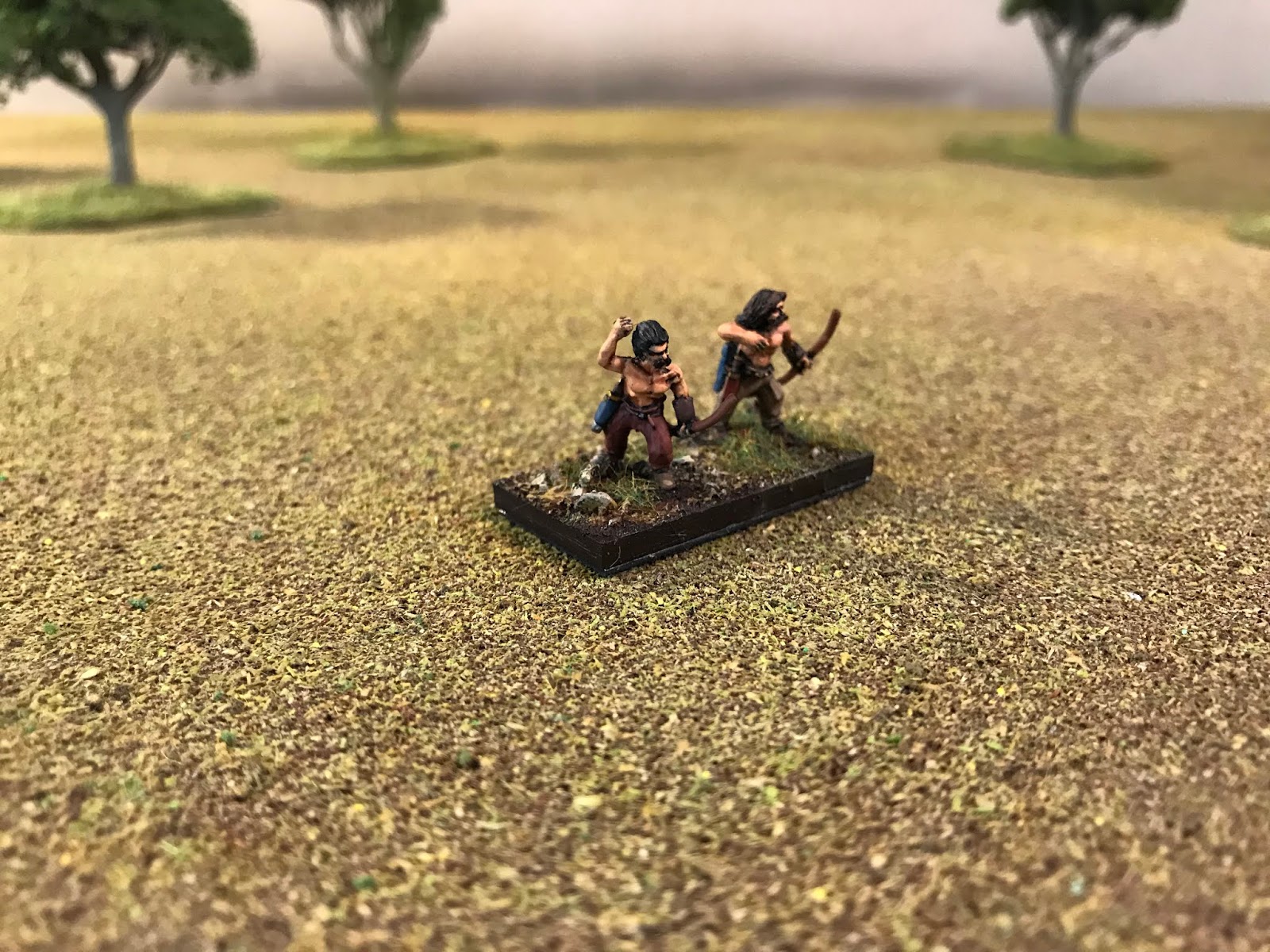
Unlike Hamlet, I thoroughly enjoyed working through these slings and arrows, although I appeared to have purchased far more than I require in that the DBMM army lists which I am using as a guide allow for six elements of either, and I appear to have purchased the equivalent of twenty-four.
It wasn't a big task though, and they may come in handy at some point in the future. First up are thirty-two slingers:
There is a choice of four figures in the Xyston range, so a variety of possible combinations when arranged on bases of two figures each:
A few of the bases have pebbles scattered on them, which is ready ammunition for sling-armed troops:
I often wondered how much of an injury a slinger would do to a heavily-armoured opponent. I had no doubt that a skilled slinger could seriously injure the enemy with a well-directed missile which would undoubtedly be travelling at a substantial velocity, but when I saw these ancient Greek lead pellets fashioned as bullets in the New York Met it gave me a whole new appreciation as to how deadly a weapon it could be, in the right hands.
I can also vaguely recall having read somewhere that it generally wasn't just a case of picking up the nearest pebble, and that there was a much greater level of discernment in the choice of missile:
The Gallic archers were also fun to paint, with a choice of four quite dynamic-looking poses:
There is quite bit of detail on these for 15mm figures, including the fletching on the arrows:
There is some nice definition on the faces and torsos of the figures, and I was happy with the way it was possible to build up some depth to the skin tones:
I was hoping to get this project completed by Christmas but realise I still have close to a couple of hundred figures and a few long lunches to get through before then, so it will be more likely January before it is finalised. My gaming group normally takes a break until mid to late January anyway, so it will give me a bit of time to finish ploughing my way through DBMM version 2.1 in preparation for a few ancients games we have planned for the New Year.
Saturday, 24 November 2018
Gallic Unarmoured Cavalry
The output for November has been a little slow, mainly due to the family heading off for a quick two-week break in New York, which we all thoroughly enjoyed. I did however manage to complete the last of the Gallic cavalry with forty-eight of the Xyston unarmoured figures, on sixteen bases of three figures each:
Once again a selection of four figures in each pack, which I find helps maintain interest while allowing for some variety in basing:
The shield designs are by Little Big Men Studios. These fitted most of the shields perfectly, although there were a few larger shields supplied with these figures which required some blending around the edges (although not seen here):
That's the last of the Gallic cavalry, with sixty-nine figures or twenty-three bases in all, this addition represents all that are planned for the Gauls cavalry-wise, chariots aside:
Back to New York for a moment, though. This was my first visit there and I was pleasantly surprised how welcoming everyone was, given how busy it is. We did the touristy stuff; took in a show at Broadway (The Lion King), ate at the New York diners, walked through Central Park in the snow and went to the Met, where I found this:
A composite figure, but great to see up close having recently completed a 28mm Ottoman Turkish Army.
Thursday, 18 October 2018
Two more 15mm Gallic warbands
Another 120 Gallic warband figures completed, which amounts to 30 additional elements of four figures each:
Given that they are 15mm I probably should be knocking them out much faster than I am, but the Xyston figures are quite detailed and I find myself fiddling around a fair bit in an attempt to bring out the detail:
I particularly like the figure on the right-hand side of this command stand, waving his sword and dragging a rather large carnyx around; a Gallic trumpet, for those wondering:
I became a little bored with the 'standard' 40mm x 20mm bases, so experimented with a few 40mm square bases with eight figures on each:
While I do quite like the ability to arrange the figures in a more irregular fashion, painting the bases once the figures were in place was much more difficult:

That said, I'll probably try a few more as it will assist figure movement around the table and hopefully lessen the number of spears that will have to be reattached:
There are another 48 or so Gallic cavalry in the queue which I should have completed over the next month or so. That should represent the half-way mark of this particular project and, once completed, I'm thinking of segueing back to some Foundry French cuirassiers I have prepped and which have now accumulated a thin layer of dust.
I find going up to 28mm figures after 15/18mm is always such a pleasure, and wish I could remember to change things up or down more regularly.
I particularly like the figure on the right-hand side of this command stand, waving his sword and dragging a rather large carnyx around; a Gallic trumpet, for those wondering:
I became a little bored with the 'standard' 40mm x 20mm bases, so experimented with a few 40mm square bases with eight figures on each:
While I do quite like the ability to arrange the figures in a more irregular fashion, painting the bases once the figures were in place was much more difficult:
That said, I'll probably try a few more as it will assist figure movement around the table and hopefully lessen the number of spears that will have to be reattached:
There are another 48 or so Gallic cavalry in the queue which I should have completed over the next month or so. That should represent the half-way mark of this particular project and, once completed, I'm thinking of segueing back to some Foundry French cuirassiers I have prepped and which have now accumulated a thin layer of dust.
I find going up to 28mm figures after 15/18mm is always such a pleasure, and wish I could remember to change things up or down more regularly.
Subscribe to:
Posts (Atom)