Saturday, 31 December 2016

Loyal Lusitanian Legion

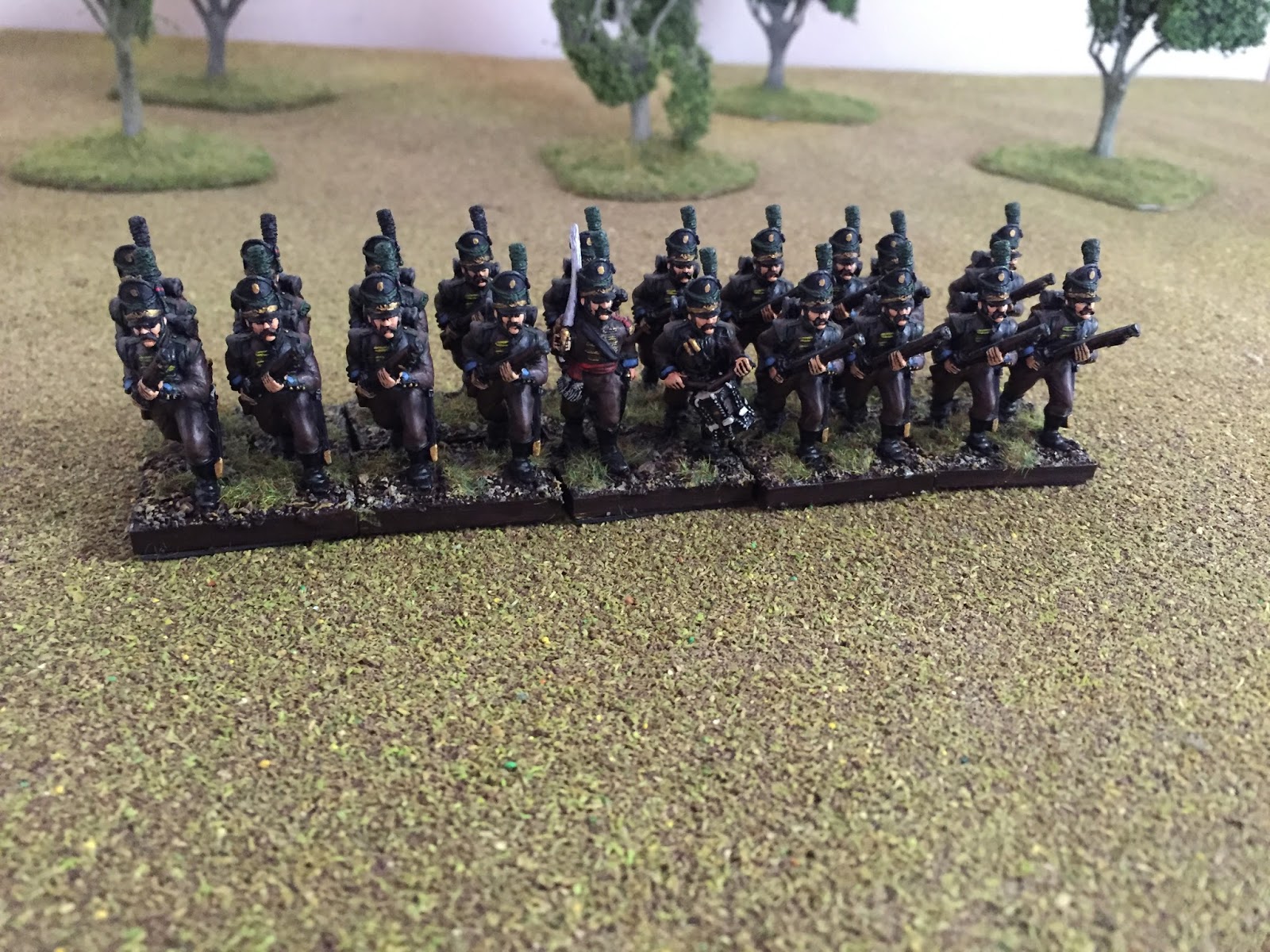
As I have found to be usual at the end of most of my projects I had a number of surplus figures, in this case twenty or so Portuguese lights. Since I have already completed all six of the early Cacadore regiments the only way I could use them was to put together a battalion from the Loyal Lusitanian Legion, or LLL as they were identified on their brass shako plates:


There are however two potential inaccuracies in that the lacing on the cuffs was pointed, as opposed to square as was the case with the Cacadore regiments, and it is doubtful that they wore the barretina - being raised and equipped in England they were almost certainly initially outfitted with the stovepipe. However, I can vaguely recall I read somewhere that they were depicted at some stage in Portugal in the barretina, although I can't now recall where I read this or if it might just have been wishful thinking on my part:


Oman probably does them something of a disservice when he describes them as an "abnormal force", but I suppose what he means is that they were almost a microcosm of an army within an army, nominally comprised as they were of three battalions of infantry with paper strength of a thousand men each, a regiment of cavalry comprised of three squadrons, and a battery of artillery (although it is doubtful whether the cavalry ever reached much more than squadron strength, due to the paucity of horseflesh):


As many might know the Legion was initially under the command of Sir Robert Wilson, who comes across as an independent adventurer, albeit a man of some capacity and who, it could be imagined, would relish having the three arms in a small mobile force which could strike and then move quickly. It is also not hard to imagine that this would not sit too well with Wellington, and Wilson departed fairly soon after the former's arrival to seek adventure elsewhere.

The Legion would ultimately be absorbed into the regular Portuguese army in the form of the 7th, 8th and 9th Cacadores, although it is interesting to note that the first battalion of the Legion was with Beresford defending the town and bridge at Albuera while the 8th Cacadores were with Wellington at Fuentes de Onoro, which does imply that even as late as mid-1811 the LLL continued to operate concurrently with the units into which they were to be eventually amalgamated.

There is a lot more to the LLL than that, and one book I have on the reading list for 2017 is Lillie and Mayne's book to flesh things out more.


All things considered it was just nice to paint something in green again and, above all, to have finished the Portuguese army. I'll try to get them all out for a group photo before moving on to the next project. I'm still struggling with that one, and know I need to paint some French, but the call of the Calpe Prussians and Saxons is increasingly hard to resist.

That's one for the New Year though, and I hope everyone who reads this has a happy and successful 2017!


Tuesday, 27 December 2016

Portuguese 6th Porto Cacadores

The last of the early Cacadore regiments, and the second to last unit of this project, the 6th Cacadores were distinguished from the more famous 3rd by their yellow collars:


They formed part of Campbell's brigade at Bussaco, and were with Ashworth at Fuentes de Onoro, Vittoria and the battle of the Nivelle:


That's all six early Cacadore battalions now completed, for a total of 120 figures in all.


I now just have to complete one battalion of the Loyal Lusitanian Legion, which I am hoping to have done by New Year's, and that should be it for this particular project.

Friday, 23 December 2016

Portuguese 3rd Villa Real Cacadores

The fifth and penultimate Cacadore regiment, the 3rd was probably the most famous of the Cacadore regiments beside the 1st:


These two regiments spent most of the war operating alongside each other and were an important element of the elite British Light division at Bussaco, Fuentes de Onoro, Salamanca, Vittoria and beyond, which meant that they were consequently usually heavily engaged:


The yellow cuffs and brown collars distinguish them from the 6th, which had yellow collars and cuffs and is the last Cacadore regiment I have to complete:


That should leave me with just enough figures for one battalion of the Loyal Lusitanian Legion, and I must confess that I am looking forward to being able to put away the browns and paint a few figures in green for a welcome change.

Thursday, 1 December 2016

Portuguese 5th Campo Mayor Cacadores

The second of the Portuguese early war Cacadore regiments with red facings, the 5th saw action at Albuera, Salamanca and Vittoria, and also the battle of the Nivelle where they do not appear to have been heavily engaged from the returns published in Oman:


The only difference between the 2nd and 5th regiments was that the former had a brown collar while the latter had red, with both carrying red cuffs:


I used the Front Rank skirmishing figures for these which consist of five different poses, not counting the command figures, so there is a little bit of variety in there to keep me entertained:


That's four battalions completed, with the last two to be hopefully finished before Christmas:


Monday, 21 November 2016

Portuguese 2nd Moura Cacadores

I enjoyed painting the 2nd Cacadores, comprised as they are from Front Rank's Portuguese Cacadore skirmishing figures which offer a reasonable variety of poses:


It was also nice to switch to red facings, even if it is only the cuffs in this case:


From Oman it appears that the 2nd saw service under Coleman at Bussaco, Doyle's brigade under Houston at Fuentes de Onoro, Collins's brigade at Slamanca, Lecor's brigade under Dalhousie at Vitorria, and then back under Doyle for the battle of the Nivelle and Orthez:


Reading the Oman OOBs it is quite apparent how British trust in the Portuguese manifested itself over the course of the Peninsular War in the establishment of brigades formed solely of two Portuguese line regiments supported by a regiment of Cacadores, which continued to acquit themselves with the utmost distinction:


The 5th will be the next unit, mainly because they also have red facings, after which I am planning to complete the famous 3rd regiment alongside the 6th Cacadores.


Saturday, 29 October 2016

Portuguese 4th Viseu Cacadores

The 4th Cacadores, as with most of the Cacadore regiments, were heavily engaged throughout the Peninsular War and saw action under Pack at Bussaco, Salamanca and Vittoria, and as part of Wilson's brigade under Hamilton at the Battle of the Nivelle. They were also present as part of Campbell's brigade at the battle of the Nive:


The uniform and facings are almost identical to the 1st Cacadores, except that the 4th had a sky-blue collar as opposed to brown:


As with all Cacadore regiments around this time, the elite atirador companies were distinguished by black shako plumes, and  green fringes on the end of the shoulder straps, and were armed with the legendary Baker rifle:


I have four more of the early Cacador regiments to complete, which will leave me with a seventh. I'm probably going to have a go at painting them as a battalion of the Loyal Lusitanian Legion to provide a bit of variety, but that is probably a month or two away.

Wednesday, 19 October 2016

Portuguese 1st Castello de Vide Cacadores

The first and possibly most highly regarded of the Cacadore regiments alongside the 3rd, the 1st Cacadores were present at most significant Peninsular War battles aside from Albuera. This included being part of the Light Division under Craufurd at Bussaco and Fuentes de Onoro, under the command of Alten at Salamanca and Vittoria, and present at most of the conflicts in the crossing of the Pyrenees and into France including the battle of the Nivelle and the series of encounters which formed the battle of the Nive:


I had a slight conceptual struggle with this unit before I began, in that most Portuguese Cacadores around the 1808 to 1809 period are represented with the barretina and with yellow lace, but Chartrand states that this was only a very short-lived phenomenon and that most very quickly adopted black, due to cost and availability, and possibly because it was quite conspicuous. This implied that Cacadores wore black lace with the barretina, even before the later adoption of the stovepipe shako:


In the end though I went with the yellow lace, with gold for the officers, on the basis that this is what is typically represented on the early Cacadores and therefore probably more recognisable:


I have figures for all six of the earlier cacadore regiments, and hope to have the remaining five completed this side of Christmas, in addition to some spares that might be enough to make up a seventh: