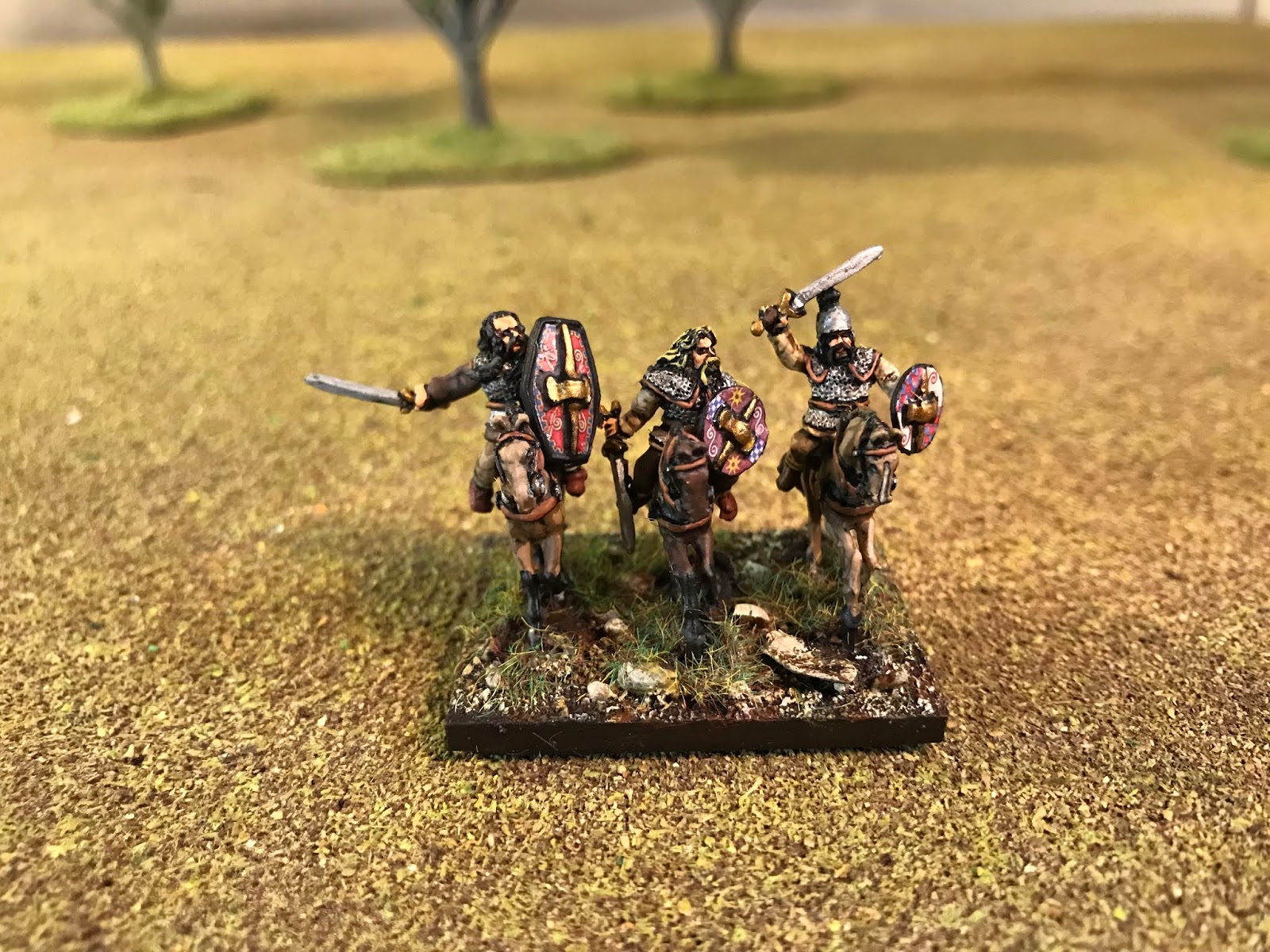
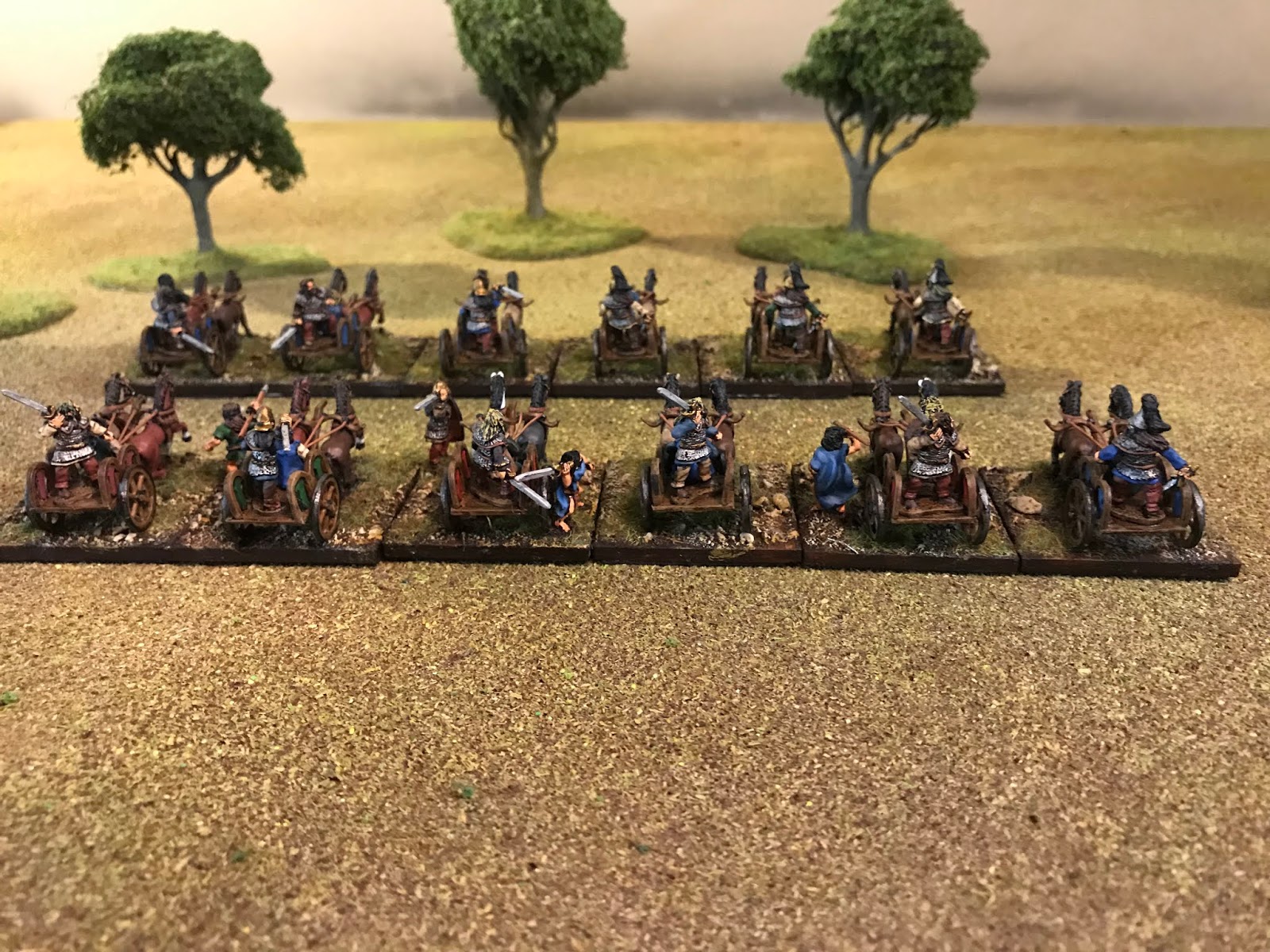
Monday, 25 March 2019

Latest Batch of 15mm Spanish Scutarii

Another twenty-four elements of seventy-two scutarii figures completed, making fifty elements completed so far with only a dozen or so left to go:
The figures are, as usual, Xyston and the shield transfers are by Little Big Men Studios:


These are mainly javelin-armed with four different poses per pack, alongside the four blade-armed figures:


I have maintained the theme of mainly using browns, cream and white linen for the tunics, with black or red for the helmet crests, which I think makes for a pleasing combination:


The shield designs are now starting to repeat themselves, but there are around forty-eight different patterns so hopefully it shouldn't be noticeable en masse:


With a bit of a push I should have the scutarii completely finished by the middle of April:


Given that this troop type represents the bulk of a Spanish ancients army, that should be about the halfway point of the project. We are playing a Carthaginian versus Spanish DBMM game this Saturday, so it will be nice to get them on the table so soon after completion.

Wednesday, 13 March 2019

More 15mm Spanish Scutarii

Having just completed a 15mm Gallic army I was very keen to get stuck back into the 15mm Ancient Spanish project I had started and managed to complete another eighteen elements of scutarii, including most of the command elements and standard bearers I'll need for all these units:


All the figures are again Xyston, with the shield transfers by Little Big Men Studios:


When I first looked at the LBMS shield transfers I was a little wary as they involved, in most cases, cutting out the middle of the shield boss. This involved catering for a few unusual shapes on some of the shields, but I soon got into a rhythm and found that if I could do this accurately enough they were actually far easier to position than the Gallic shield transfers:


The Xyston Spanish figures are a delight to paint as usual, and they are more like a large 18mm than a true 15mm figure:


There are two options for the standard bearers, with a choice of a pennant:


or a bull-like standard:


The figure below on the right is possibly my favourite Xyston figure thus far. Unfortunately it is not the best picture, but I very much like the dynamic pose and the way he is leaning back prior to letting loose with his javelin:


That's twenty-eight elements of scutarii now completed, with around another forty to go. These are in the queue at the moment so, when finished, will see the backbone of this Spanish army completed.

Thursday, 7 March 2019

15mm Gallic Army Completed

Having completed the last six elements of this army earlier this week, I wanted to gather the army for a group shot. Given that most of the DBMM games we are currently playing are set at 400 points it is unlikely that they will be assembled together again for any one single game, although if I can convince the group I game with to give To the Strongest a go at some point I may need most of what I have managed to complete:


The figures are Xyston, and all shield transfers are from Steve Hales of Little Big Men Studios:


A quick thank you to Steve as it had been a good six or seven years since my original purchase of the transfers and some of them refused to part from their backing paper. I checked in with him to confirm that I was indeed attempting to apply them correctly, and he offered to replace them all free of charge. Given that the fault was mine I could not in good conscience accept the offer, but he insisted on a generous discount for the replacement which I thought went way beyond great customer service.


More cavalry and chariots:


A few more warband pictures:


Lastly, the gaesatae:


And an overall picture of the entire army as assembled:


All up, the army is comprised of the following:

79 warband elements
33 gaesatae elements
12 chariots
5 soldurii elements
8 skirmish elements
8 sling-armed elements
8 bow-armed elements
16 unarmoured cavalry elements
13 armoured cavalry elements (including 3 generals)

This constitutes 598 foot and cavalry figures with 111 horses, or 709 figures in total.

I had originally hoped to get all this done within four months, but I suppose just under six months is not a bad effort and this is the largest ancient army I had in the lead pile.

Now it's back to some ancient Spanish, which I am hoping I should be able to complete before the middle of the year.

Wednesday, 6 March 2019

Last of the 15mm Gauls

While I had initially intended the project to be finalised with the completion of the Gallic chariots, I had four soldurii figures left over and also decided to place one final order for five more elements of Gallic armoured cavalry. Here they are completed:


I wanted to paint two of these with white horses, to represent a couple of additional mounted generals:


While the other three elements, with one shown here, bring the total number of armoured Gallic cavalry elements up to ten:


The soldurii are four figures left over from the two packs I ordered as chariot riders. The figures are so nice it seemed a shame not to paint them, and they have now joined their already completed compatriots:


Only a few odds and ends but this now finally represents the end of the project which, after six months, I am very happy about. Having completed the same army in 28mm ten or so years ago, I have been telling myself that these are the last Gauls I will ever paint. That is until I remembered I have thirty or forty 28mm Asterix figures somewhere in the lead pile.

I'll try to haul the completed army together for a group shot over the coming days, and then it's back to some more 15mm Ancient Spanish.

Wednesday, 6 February 2019

15mm Gallic Chariots

The DBMM army lists allow for up to eighteen chariots, but I thought a dozen would be sufficient for my needs. I was however not entirely happy with the chariot riders as initially supplied as they were all gaesatae figures, whereas I thought the Xyston soldurii would be more appropriate and especially because I wanted to base a few as generals:


I ordered two packs of soldurii and ended up with seventeen figures, using a dozen as chariot riders and putting four aside for an additional solurii element, while the spare figure and a gaesatae warrior found their way on to the chieftain's base as an additional bodyguard:


The sub-generals are likewise differentiated with one additional chariot runner each, while the remaining gaesatae were put to use in the recently completed gaesatae contingent:


The chariot models themselves came in seven parts which needed to be glued together. Not overly difficult, but they probably won't stand up to much rough handling:


The fiddliest bit was sticking some fuse wire on the models for reigns. I nearly gave up, but am glad I persevered as I think the models look better with the drivers holding something other than thin air. I did have a chuckle to myself when, just I had used up my last piece of fuse wire, the pool filter circuit board tripped about three hours later. I am sure some water got in there with rain we have had overnight, and I don't believe that modern circuits require fuse wire anyway, but I enjoyed the irony of the moment nonetheless:
The only other thing I wrestled with was cutting the riders and standing driver figures from their bases, but thought I'd end up making too much of a mess of the figures themselves. Besides which, it is really only noticeable if viewed from the rear:


That's all the units for this project completed. I still have the one element of soldurii and four more cavalry elements to finish, all recent additions, and I am hopeful I'll be able to finalise everything within the next couple of weeks.

Saturday, 2 February 2019

15mm Spanish Scutarii

While waiting for the arrival of some chariot riders to complete my Gallic army, I thought I'd embark upon another project in the queue and make a start on a 15mm ancient Spanish army. The first unit completed is comprised of ten elements of Spanish scutarii:


The figures are again Xyston miniatures, and are based in elements of three figures each:


The Xyston packs are of eight figures each, normally four with swords and another four with javelins, so I decided to keep the blades together and will base the javelin-armed figures on separate bases. I am hoping this will give me more flexibility between the DBMM Iberian and Celtiberian Spanish army lists:


The shield designs are again by Little Big Men studios, and I think they have quite a nice Spanish look to them:


I have mainly used different browns for these figures, with the occasional white and off-white tunic thrown in, to give them a more subdued look:


I was also intending to do the bases with more of an arid theme, along the lines of the Ottoman Turks completed last year, but remembered that some of these units will be fighting alongside the Gauls in several army lists and thought that different base styles in the same army may end up looking a bit odd on the table:


The unit also contains the first of six command stands, and I should be able to field around sixty elements of scutarii when completed:


We actually managed a dry-run of DBMM 3.1 today with a throw-away game pitting Babylonians against Macedonians. This was my first Ancients game since WRG Version 6, but luckily the guys I am playing with are all conversant with earlier versions of DBMM.

It still took four of us to get our heads around the rules but I found them quite enjoyable, although my hope is that we will also be able to give 'To The Strongest' a run-through in the near future.

I am hoping to complete the chariots over the following week, followed by four additional elements of Gallic cavalry which will then see the end of that project. I'll probably then try to do another couple of units of Spanish, although there are some Napoleonic French cuirassiers that have been patiently sitting atop the work desk for a year now and which I really should complete before I start losing figures.


Tuesday, 22 January 2019

Gaesatae

The penultimate block of troops for this project, the Gaesatae were apparently not a tribe as I originally believed but more a group of warriors who lived in the Southern Alps and probably hired themselves out as mercenaries. The term 'gaesatae' appears therefore to refer to many of them being armed with a spear, rather than any tribal nomenclature:
I have completed 101 figures in all, with 99 of them based here across 33 elements of three figures each, and two left over for basing with the dozen chariots I have left to complete:


They are depicted, as Gaesatae usually are, without clothing. This is following the battle of Telamon in 225 BC where they collectively decided to throw off their clothes and charge naked at the Romans:


This was apparently to throw fear into the Romans, and Polybius states there may have also been a practical reason in that they didn't want to get their clothes caught in the brambles that were growing on the slopes of the hill atop which the Romans were positioned.


Either way, it probably seemed like a good idea at the time and appears to have been pretty much a one-off. It did make painting them a lot easier than the rest of the Gallic army, although they still required four layers including a wash for the flesh-tone:


With the command and standard-bearer figures there are a dozen different poses, including a handful holding severed heads, and they all look suitably fierce. The Gauls were apparently quite fond of collecting the heads of their enemies which they used as trophies to decorate their dwellings, probably far more interesting than some of the things I have seen people bring back from their holidays and put on display in their living rooms:


Only a dozen chariots and a few late additions in the form of  a dozen armoured cavalry left to go now. The chariots are almost completed apart from a slight hold-up with the chariot riders in that they are supplied with a random assortment of warriors, but when I unpacked them I discovered they had all been supplied with Gaesati warriors. After some deliberation I incorporated the chariot riders into the Gaesati warbands to keep them all together as a single contingent, and ordered a couple more packs of soldurii which I am hoping will better look the part.