Showing posts with label Flight Deck Decals. Show all posts

Wednesday, 27 September 2023

French Fleet Completed

The last of the six fleets and the completion of my WWII naval project, this contingent was the quickest to paint. The main reason for this is that the French fleet was for the large part taken out of action early in the war, before the more intricate camouflage schemes were applied.

The French navy included some state of the art ships which were some of the fastest at the time, including the recently built Richelieu class in the Richelieu, Jean Bart and Clemenceau. The Richelieu was initially twice attacked by the British but was eventually repaired in the USA before serving with the British Home Fleet and then being transferred for action in the Pacific, while the Jean Bart fought a duel against the USS Massachusetts during operation Torch before surrendering to the Allies:


The Dunkerque and Strasbourg were similar to the Richelieu class in that their main armament was all placed forward. This was a distinct disadvantage when attacked by the British at Mers-el-Kebir as part of the controversial Operation Catapult, as they had been docked in the harbour with their sterns facing the open water which meant they were initially unable to return fire:


I also included three ex-WWI battleships in the Bretagne, Provence and Lorraine, the difference in construction over the preceding twenty years or so being quite noticeable:


Three Suffren class heavy cruisers include the Foch, Colbert and Dupleix, seen here alongside the one-of-a-kind Algerie:


With the Duquesne and Tourville completing the small contingent of heavy cruisers:


Six light cruisers include the Duguay Trouin, Primaguet and Lammotte-Picquet:


With the La Galissonniere, Montcalm and Marseillaise completing the half dozen:


Some of the French destroyers remind me of the larger Japanese destroyers in that they are almost the size of small light cruisers but maintain the advantage of being fast, such as the 36 knots achievable by the Vauqelin class, with the Vauqelin seen here alongside her sister ships Kersaint, Cassard and Tartu:


The Fantasque class was similarly large and fast, and I completed four with the Fantasque herself, the Audacieux, Terrible and Malin:


Three Le Hardi class destroyers with the Le Hardi, Mameluk and Casque complete the contingent of French destroyers:


The last ship in the fleet is the French aircraft carrier Bearn which, even though it actually launched aircraft and completed pilot training in the early part of the war, spent most of WWII out of action in the French West Indies:


Here are all thirty-two of the French fleet in their storage box:


The Nimitz ruleset we are currently using did not originally contain game cards for the French navy and I was readying myself to spend a bit of time creating in them, but a visit to Sam Mustafa's website shows they have now been released in the last week or so.

I did a quick count across all six fleets which shows I have managed to complete a grand total of three hundred and nineteen vessels, all but twenty-five of them over the past four months. I also purchased a batch of GHQ 1/2400 scale planes which I may also get around to completing at some stage, but since most rulesets use tokens or counters to represent the aerial component of WWII naval gaming these are not a high priority and will really only be used as table dressing.

Next up, a return to my ECW project with a few Parliamentarian foot regiments prepared and ready to be painted.

Tuesday, 19 September 2023

Regia Marina Fleet Completed

The penultimate contingent in my WWII naval project, I had been looking forward to getting stuck into the Italians mainly because their red and white striped aerial recognition markings are quite unique and provide a bit of colour. I was a little concerned about whether I would be able to paint lines that were straight enough without ruining the effect, but found that all the GHQ models with the exception of the destroyers had lines etched into the deck which made painting them quite simple.

I also purchased the Lifecolor WW2 Italian Naval paint set which took a lot of guesswork out of approximating the correct shades and were quite nice paints to use.

Here are the three completed Littorio class battleships which were the Littorio herself, the Vittorio Veneto and the Roma (the Impero was laid down and luanched, but never completed):


Followed by the Caio Duilio and Giulio Cesare:


Six heavy cruisers include the Trento, Trieste and Bolzano:


And three Zara class cruisers in the Zara, Fiume and Pola:


Italian spotter planes had a rather unique design, with red stripes on a very light grey background as can be seen here on the foredeck of the Zara:


I came a little unstuck on the light cruisers as some of the names are incredibly long and just wouldn't fit on my labels. The Abruzzi's full name, seen here alongside the Raimondo Montecuccoli, Muzio Attendolo and Giuseppi Garibaldi, is actually the Luigi de Savoia Duce degli Abruzzi:


While the final four light cruisers are the Attilio Regolo, Scipione Africano, Alberto Da Giussano and Bartolomeo Colleoni (which I chose as it sounded a little like Corleone to me):


The Soldati class destroyers are so-called as they are all named after different troop types. Below are the Velite, Mitragliere, Corsaro, Carabiniere and Bombardiere:


Followed by the Legionario, Ascari Artigliere and Alpino:


Three Navigatori class destroyers named after Italian explorers in the Antonio da Noli, Nicolo Zeno and Luca Tarigo, along side three Turbine class destroyers with the Turbine, Borea and Espero, complete the destroyer flotilla:


With the aircraft carrier Aquila completing the Italian fleet:


Here are all thirty-five ships nestled alongside some of the overflow from my US and Royal Navy contingents:


Only a similarly-sized French fleet left to go, which I hope to have completed by the end of next week.

Monday, 28 August 2023

Royal Navy Fleet Completed

The last of the Royal Navy ships were finished a week or so ago, with the completed Royal Navy fleet now taking its place alongside the US Navy, Imperial Japanese Navy and Kriegsmarine. Given that the Royal Navy ships were the first I started it is nice to finally complete them. The last batch includes the Nelson and two Queen Elizabeth class battleships, the Barham and Valiant:


Two more King George V class battleships in the Duke of York and Howe:


and HMS Resolution:


Four more County class heavy cruisers include the Cornwall and Shropshire:


And the two Australian County Class cruisers Australia and Canberra both in their 'Chicago blue' colour schemes which they adopted for operations alongside the US Navy in the Pacific. As mentioned previously the Canberra was sunk and a US Baltimore class cruiser named in its honour later in the war, while the Australia was the first Allied ship to come under kamikaze attack and was subsequently hit by them another six times, suffering the most kamikaze attacks of any ship during the war:


Additional light cruisers completed include HMS Manchester and Belfast:


Three RAN Leander class cruisers in HMAS Perth, Sydney and Hobart:


And another Dido class anti-aircraft light cruiser, HMS Argonaut:


Two Fiji class light cruisers, HMS Fiji and Bermuda, plus HMNZS Dunedin and HMS Dauntless complete the light cruiser additions:


I also added three 'O' class destroyers, Onslow, Offa and Onslaught, to bring the total number of destroyers to fifteen:


As we are planning a few convoy games, I decided to add several corvettes and destroyer escorts to the fleet. The four Flower class corvettes, Clematis, Arbutus, Samphire and Sunflower are tiny models, seen here together and next to a pencil for scale:


The three Hunt class destroyer escorts, Bicester, Exmoor and Grove are also considerably smaller than the usual destroyer models:


Five U-class submarines, Union, Umpire, Ultor, Unruly and Urge will also be useful for campaigns, if we manage to get one off the ground:


I completed three more fleet carriers with the Victorious, Formidable and Hermes shown below:


Along with several escort carriers for the aforementioned convoy games. These include HMS Attacker, Battler, Archer, and two converted grain carriers in the Empire MacAlpine and Empire MacRae. These latter two carriers continued to transport grain, and therefore had both a merchant crew and a Royal Navy crew to service and fly the four Swordfish aircraft they carried:


Finally, here is HMS Archer alongside the Ark Royal, just to give an idea of the difference in size between an escort and fleet carrier:


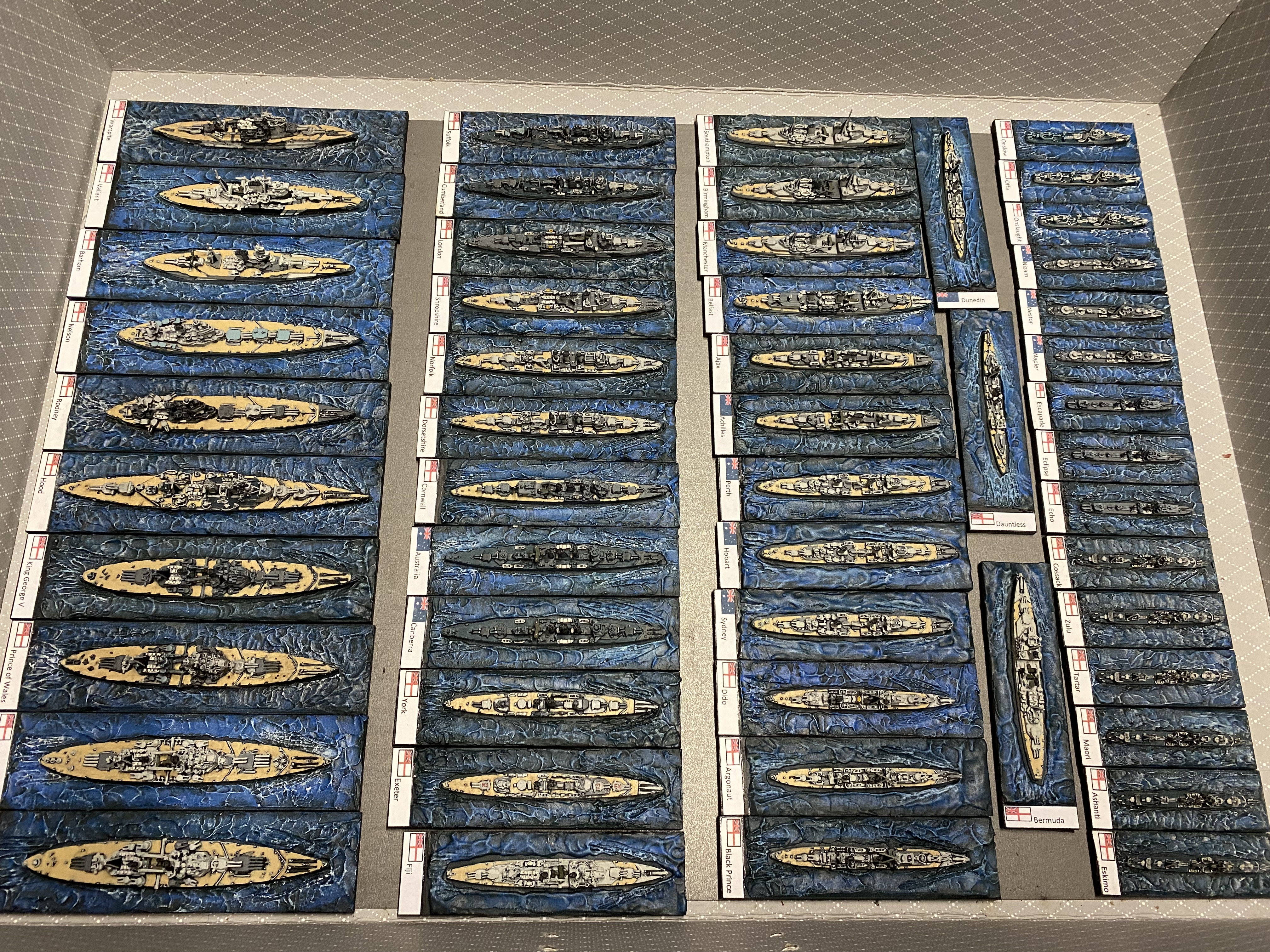
The entire Royal Navy fleet consists of 79 models in total, most of which fit snugly in one A3 storage box although the carriers and a handful of battleships have had to find a home alongside some of the overflow from the US and Japanese fleets:


Next up will be the completed merchant and transport ships, only a dozen or so, and then the Italian and French fleets to complete the project. 

Monday, 14 August 2023

US Navy Fleet Completed

Following on from my earlier promise not to drag out too many posting for this project lest I turn this into a naval wargaming blog, here are the recently-completed sixty-nine ships comprising my US Navy fleet. 

First off, three Iowa class battleships in the Iowa, Missouri and New Jersey. I have always thought this is one of the most beautifully designed classes of battleships and they are the most expensive under the Nimitz rule system at 48 points each, compared to the Yamato's 45 points and an average of around 35 points for most other battleships. It was a particularly memorable experience to be able to spend an hour or so fossicking through the Missouri in Pearl Harbour a few years ago:


The South Dakota, seen here with her sisters Indiana and Alabama, are to my eye also beautifully designed and pack quite a punch:


Next up the North Carolina and Washington alongside the USS Texas:


The US Navy camouflage system was quite easy to follow and again I purchased some "authentic" US Navy colour sets from Lifecolor. Decks were painted blue throughout most of the war, and Measure 22 complemented with a Navy blue hull makes for some quite dark colour schemes. Where I was forced to used this I used another earlier war US Navy colour called Ocean Blue, just to lighten things up a little as on the Pennsylvania below, seen here alongside the Mississippi, Colorado and Nevada:


I completed six Baltimore class heavy cruisers including the Baltimore, Boston, Quincy, Canberra, Pittsburgh and Saint Paul. The Canberra was actually named in honour of the Australian County class cruiser which had been lost operating alongside the US Navy in 1942 and was the first US warship named after a non-US capital city. The second USS Canberra was commissioned a couple of weeks ago in Sydney which is the first time a commissioning ceremony for a US Navy warship has been held outside the US:


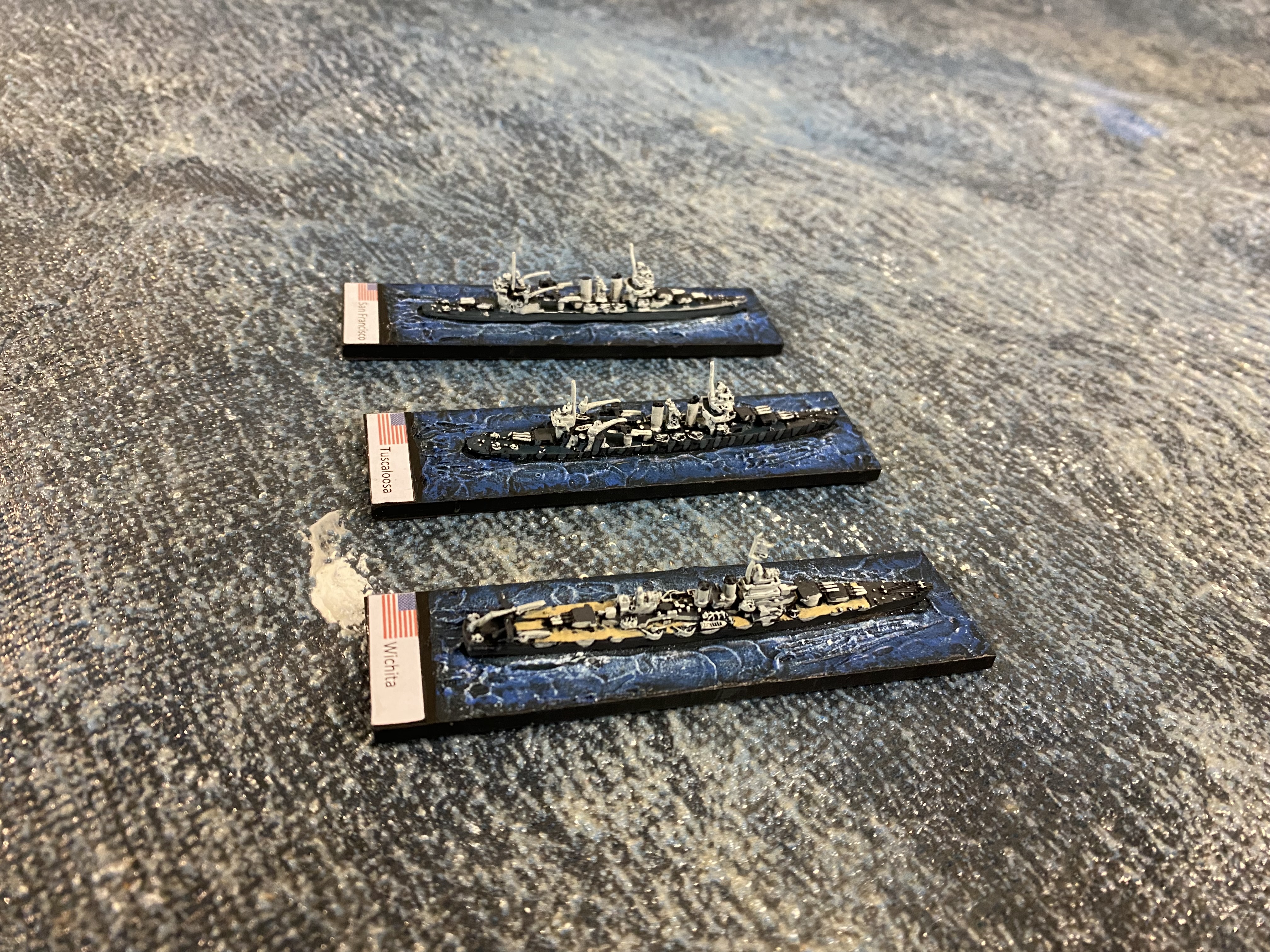
Below are two New Orleans class heavy cruisers in the San Francisco and Tuscaloosa, alongside the one-of-a-kind Wichita:


The Northampton, Chicago and Houston:


and the Portland and Indianapolis, alongside the light cruiser Detroit. The Indianapolis is famous for delivering the components for the atomic bomb that was to be dropped on Hiroshima, and was sunk by a Japanese submarine four days later. The 600 survivors had a terrible time and it is estimated that between 40 to 150 were taken by sharks:


The four Brooklyn class light cruisers here are Brooklyn, Philadelphia, Honolulu and Helena: 


With three Cleveland class cruisers in Cleveland, Miami and Colombia:


And three Atlanta class light cruisers in Atlanta, Juneau and San Diego:


I completed fifteen destroyers in total, with six Fletcher class destroyers; the Fletcher, Radford, Jenkins, Ross, Laws and Pritchett:


Three Benson class destroyers with the Benson, Madison and Laffey, and three Porter Class with the Porter, Phelps and Moffett:


And finally three Bagley class destroyers with the Bagley, Blue and Henley:


While I was looking up the colours for the Porter Class destroyers I stumbled across the story of the USS William D. Porter, a Fletcher class destroyer and what became known as the "unluckiest ship in the Navy". Unlucky is probably being a little generous as its voyage to escort the Iowa on its mission, in strict secrecy and radio silence, to transport Roosevelt to the Tehran conference began with the William D. Porter flailing an anchor which destroyed the lifeboat mountings and railings of a ship moored alongside. 

Joining the taskforce the following day, the William D. unfortunately let loose a depth charge which exploded, causing the Iowa and all the other escorts to scatter in the belief they were under U-boat attack. In one report I read  the Captain of the destroyer messaged the Iowa to explain what had happened and was subsequently chastised for breaking radio silence. Either way, the following day the task group decided to demonstrate their anti-aircraft drill to Roosevelt, to be followed up by a mock torpedo attack on the Iowa. While three out of the four torpedoes launched by the William D. Porter were the correct dummy torpedoes, the fourth was a live torpedo. Unsure now what to do with a live torpedo heading toward the Iowa with the US President on board, but also cognisant of not breaking radio silence again, the ship decided to signal the Iowa using a signal lamp but unfortunately sent the wrong message that the destroyer was about to reverse rather than it had launched a live torpedo. Luckily the torpedo detonated harmlessly behind the Iowa and Roosevelt must have seen the funny side as he apparently subsequently commuted the sentence of the sailor responsible, there being no other charges laid.

Next up are five Gato class submarines, the Gato, Cod, Darter, Flasher and Wahoo. There was no way I could resist including a submarine named Wahoo:


One of the most difficult things at times to follow was the US Navy's doctrine of renaming ships that were under construction for those that were lost. On reflection this is quite a clever tactic as it not only helped raise additional funding at home but must also have completely demoralised the Japanese when they thought they had sunk a ship, only to see its namesake re-emerge but with bigger and better capability. I know it demoralised me a little when I realised I had initially purchased the incorrect transfers from Flight Deck Decals for the Yorktown, seen here below in its Essex class reincarnation alongside the Essex herself, the Intrepid and the second of the carriers named Lexington.


The Hornet is another where I ended up with some spare decals, the below being the original Yorktown class carrier with a sister carrier Enterprise, alongside Ranger and Independence:


Finally, two fleet oilers Neosho and Sabine:


In the end the Japanese were overwhelmed not only by sheer numbers, but also the quality of what was being produced. There is no doubt that the US lost many lives at sea, and ships sunk are not always indicative of the lives that are lost to others that came under severe attack and managed to remain afloat, but I was genuinely surprised at how few ships above light cruiser the US Navy actually lost considering how heavily engaged they were throughout the Pacific. To my mind this just serves to underline how balanced the US Naval forces were and how severely the Japanese underestimated the industrial capacity of the United States.

Here is the bulk of the collection in its A3 storage box, with the carriers, fleet oilers and four of the battleships stored elswehere:


Next up, the last of the Royal Navy ships, and then the last two fleets in my Italian and French contingents.