Sunday, 1 March 2015

Portuguese Dragoons

Possibly one of the biggest problems the Portuguese cavalry faced at the beginning of the Peninsular War was a lack of definition as to exactly what their role should be. While apparently quite able, they appeared to be expected to perform all roles from light hussars to heavy dragoons.

There was also a distinct lack of suitable mounts, which meant that most regiments remained under-strength for most of the war. That said, it could reasonably be argued that they acquitted themselves on most occasions with nearly as much effectiveness (not to greater mention restraint) than their British light dragoon counterparts.

I have settled on three regiments of Portuguese Dragoons in the 1st Alcantara, the 4th Mecklemburg and the 11th Almeida.

Firstly, the 1st Alcantara who were present at Albuera (although by then they were probably sporting a cylindrical British-style light dragoon shako), and outside Badajoz a few weeks earlier when they ably charged and engaged a regiment of French dragoons:


Next, the 4th Mecklemburg:


As with the artillery, I adapted some Essex British light dragoons, mainly to obtain the distinctive Tarleton helmet worn by earlier Portuguese dragoons. The main differences are that the British light dragoons had chords on their jackets, which were quite easily cut off with a Stanley knife, and that the Portuguese had brass shoulder straps, and which I have attempted to paint "free-hand":
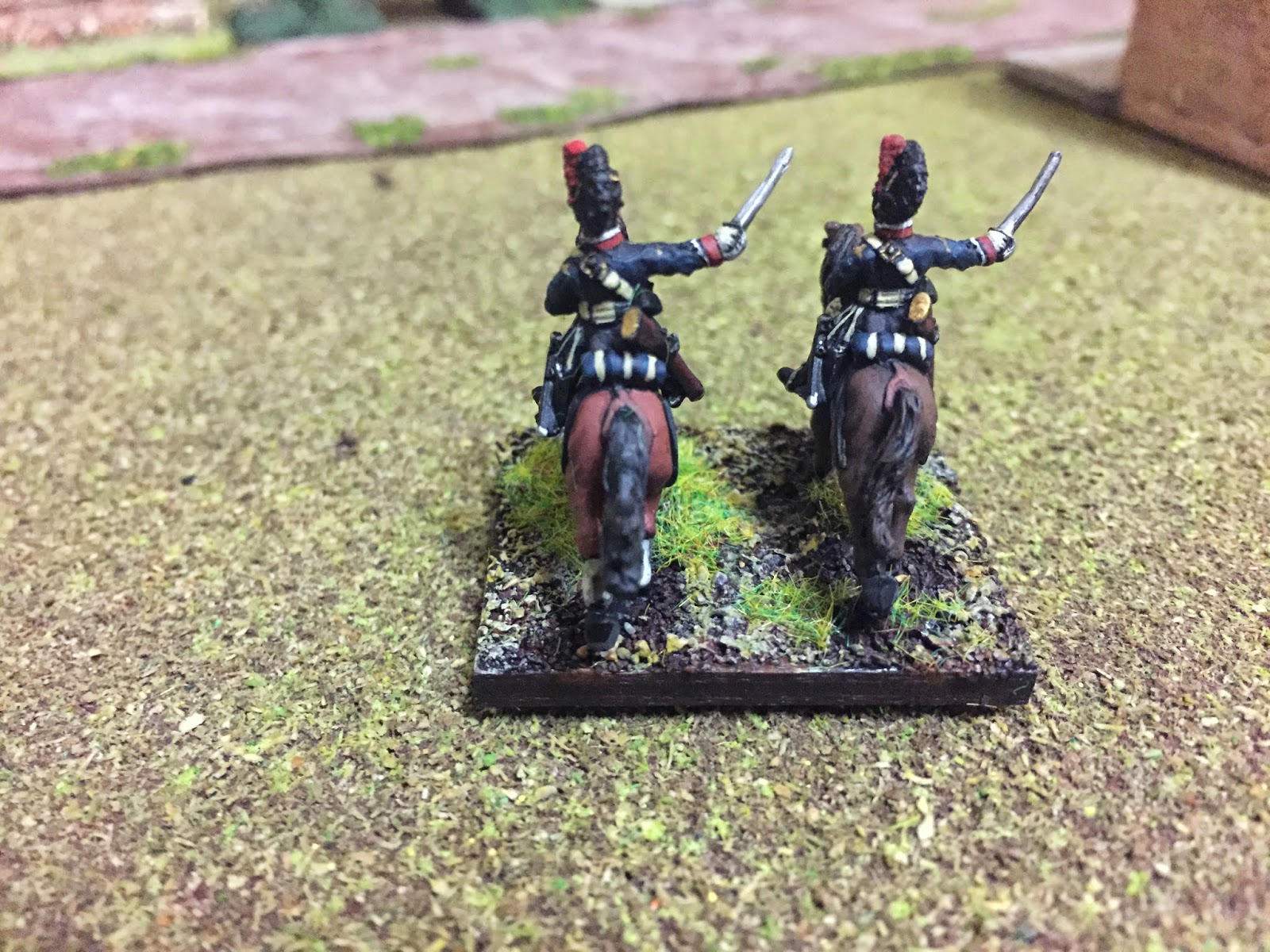


Finally, the 11th Almeida who, along with the 1st Alcantara, also fought at Salamanca:
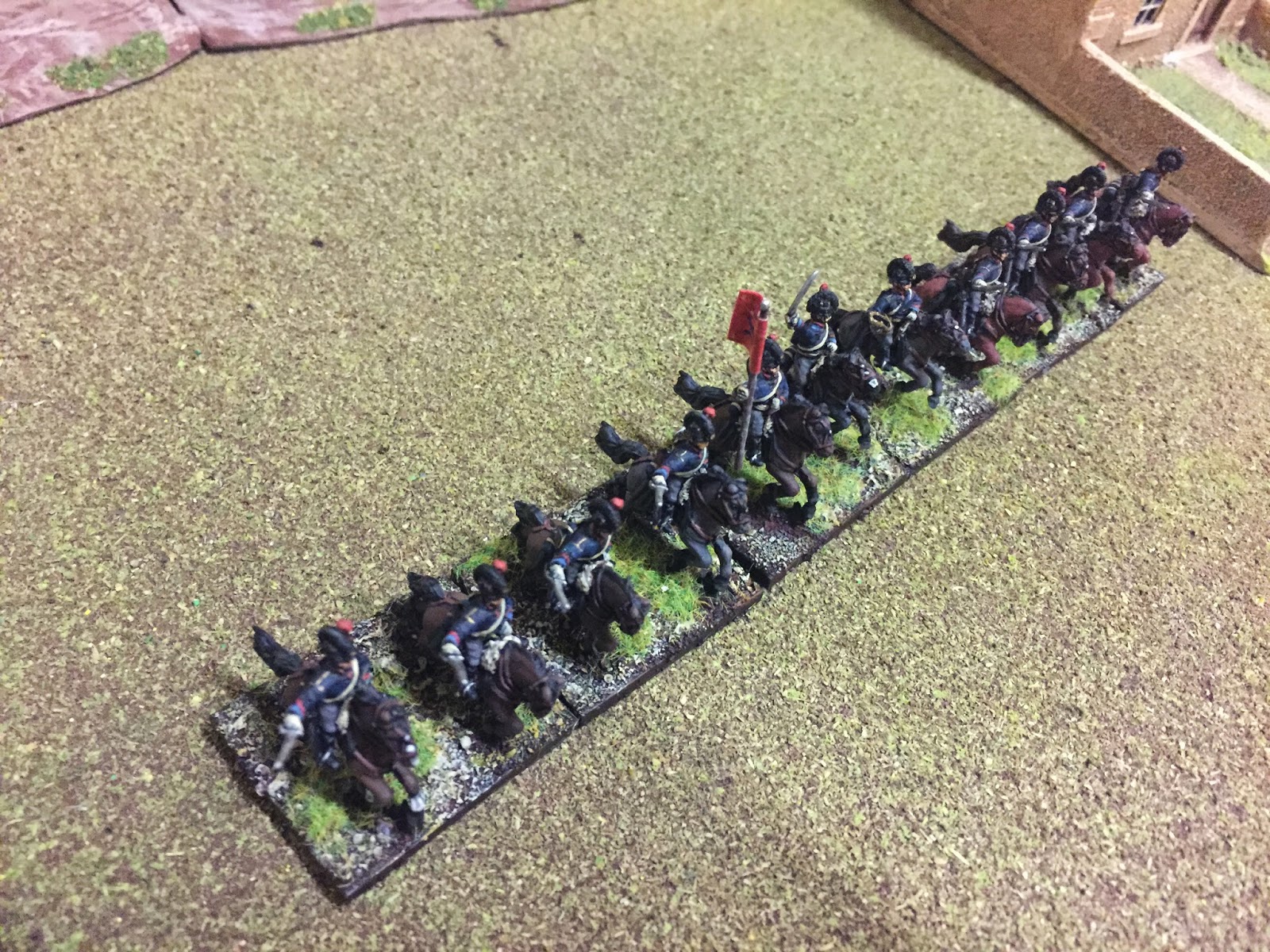


And all three together:


Well, that's the cavalry done, and probably enough for any Portuguese army. Now on to a few generals and staff...

Monday, 23 February 2015

Portuguese 15mm Artillery

A  compromise here, in that I have utilised Essex British 1815 artillery as a proxy for Portuguese batteries. This is mainly because Essex tend to be a "true" 15mm figure, and any of the other manufacturers do tend to tower over them a little:


That said, the barretina shakoes on the figures and the actual cannon themselves are possibly not that far off:


The cross-belts and equipment are possibly a little more problematic (although I quite like the way the gunners appear to be in the midst of heated discussion in this picture):


The only slightly annoying thing about these figures is that, as with most Essex artillery crew, there is a random assortment of poses. That in itself is usually fine, but in this case I ended up with seven of the eighteen crew holding rammers. Only a minor quibble in the great scheme of things, and the figures were quite nice to paint.

At least it is another unit done, and I don't think they will look too far out of place. I now only have the cavalry, general staff and militia to complete, which I am hoping to achieve before the end of March 2015.

Sunday, 22 February 2015

Remaining Portuguese Cacadore Battalions

The last five battalions of Cacadores for my 15mm Portuguese army. The first two represent the 3rd Villa Real and the 6th Porto, while the remaining three are again the 3rd Villa Real, the 4th Viseu and the 5th Campo-Mayor, but this time formed into line.

Firstly, a couple of figures from the 3rd Villa Real deployed in open order:

And the 6th Porto, also deployed in open order:

and, the 3rd, 4th and 5th formed into line:
I did briefly entertain the idea of painting these last three regiments as battalions of the Loyal Lusitanian Legion who, at the start of the Peninsular War, wore green  jackets and pantaloons, which would have provided a nice bit of variety. The only problem is that the Essex Cacadores have the barretina shakoes, whereas the Lusitanians appear to have worn the a stovepipe cap from the outset.

The other thing is that, "technically" speaking, the jacket cords were officially yellow up until 1811. I preferred to run with the information in Rene Chartrand's excellent Osprey on the Portuguese army however when he indicates that from July 1809 (at least) soldiers and officers started swapping to black cords and buttons by reason of expense, but also because black was a little less distinct than on the battlefield than yellow. Not that attempting to "blend in" with the surroundings appeared to be high on the list of priorities of many Napoleonic armies.

Thursday, 11 December 2014

Portuguese Cacadore Battalions

I have recently managed to complete four Portuguese Cacadore  battalions, starting with the 1st Castello de Vide regiment:


The Portuguese Cacadore regiments were comprised of one battalion each, and distinguished themselves in many battles in the Peninsular and Southern France. One of the most distinguished is the 2nd Moura regiment which saw action at the battles of Bussaco, Salamanca and Vittoria among others:


The 4th Viseu is quite similar to the 1st, but with a Light Blue collar instead of brown:


While the 5th Campo-Mayor is the same as the 2nd, but with a red collar:


One company in each battalion were armed with rifles, which is a nice surprise for an unsuspecting opponent. These troops were distinguished by black shako chords and plume:


The Essex figures are quite good, if a little smaller than their equivalent AB figures, but mounting them on a 3mm base gives them a bit more height:


Another five Cacadore regiments to go, which is probably disproportionately too many but I appear to have accidentally over-ordered somewhere along the line. Hopefully I will have them completed over the Christmas break and can then move on to some artillery and the cavalry.

Saturday, 15 November 2014

Viera Tellas and Serpa Portuguese Regiments

The last two of my 15mm Portuguese line regiments just completed, making eight in all (or the equivalent of sixteen battalions). Firstly, the 16th Viera Tellas:


and the two battalions of the 22nd Serpa:


These figures, while still being a true 15mm, are much more enjoyable to paint than some of my other Essex figures. There is quite a lot more dynamism in these, and I am pleased I added a few "firing" line figures into the mix:


Now, on to complete eight regiments of cacadores (I still have no idea how I ended up with so many)...

Thursday, 6 November 2014

Spanish Light Battalions

I have finally managed to get around to putting the finishing touches on a few Spanish light battalions, including the Gerona and 1st Cataluna light regiments:


With the Gerona battalion at the front:


These are probably not the most "dynamic" of the Essex figure range, and quite noticeably shorter than, for example, AB Miniatures (by at least 3mm), but they do the job nonetheless.

The 1st and 2nd Aragon battalions:


The 2nd Barcelona:


And a formed unit of 2nd Cataluna, just in case I need to pull one back into the line:


That's it for the Spanish light. Now I just need to put the finishing touches on 19 battalions of line, and half a dozen rural militia battalions...

Friday, 26 September 2014

Portuguese Line Regiments

Another four regiments, or eight battalions of nineteen figures each, completed over the past couple of months.

Firstly, the first and second battalions of 10th/2nd of Lisbon line regiment:


Again using 15mm Essex Miniatures, with GMB flags. There are a few variations included in each pack of line, which relieves the monotony somewhat. These seem to be mainly around the direction in which the heads are facing, although there are two distinct styles, one of which is slightly squatter than the other and which would appear to be of a later vintage.

That said, they are the same height, which is 15mm from top of base to eyeball, rather than the 18mm of other figures such as AB. To compensate for this, I have used the larger 3mm Litko base, so that they won't appear too small against their AB protagonists:


Here are the two battalions of 1st of Lisbon:


Both regiments formed part of the first or Central division in the Portuguese army, as indicated by the white piping and regimental flag. As mentioned, all battalions are of 19 figures which at a 1:40 ratio represents a full paper-strength of 760 men.

I also managed to complete two regiments from the second or Southern division. with red piping and standard. First, the two battalions from the 5th regiment, or 1st Elvas:


and two from 14th Tavira:


This is how all eight battalions arranged together appears:


All  the above formed part of Beresford's Portuguese contingent at Albuera although, by that stage, they had probably all adopted the later British-issued uniform with the stovepipe, as opposed to the barretina shako.

Only two more line regiments or four battalions to complete now, and then on to some Cacadores.