Monday, 28 August 2023

Royal Navy Fleet Completed

The last of the Royal Navy ships were finished a week or so ago, with the completed Royal Navy fleet now taking its place alongside the US Navy, Imperial Japanese Navy and Kriegsmarine. Given that the Royal Navy ships were the first I started it is nice to finally complete them. The last batch includes the Nelson and two Queen Elizabeth class battleships, the Barham and Valiant:


Two more King George V class battleships in the Duke of York and Howe:


and HMS Resolution:


Four more County class heavy cruisers include the Cornwall and Shropshire:


And the two Australian County Class cruisers Australia and Canberra both in their 'Chicago blue' colour schemes which they adopted for operations alongside the US Navy in the Pacific. As mentioned previously the Canberra was sunk and a US Baltimore class cruiser named in its honour later in the war, while the Australia was the first Allied ship to come under kamikaze attack and was subsequently hit by them another six times, suffering the most kamikaze attacks of any ship during the war:


Additional light cruisers completed include HMS Manchester and Belfast:


Three RAN Leander class cruisers in HMAS Perth, Sydney and Hobart:


And another Dido class anti-aircraft light cruiser, HMS Argonaut:


Two Fiji class light cruisers, HMS Fiji and Bermuda, plus HMNZS Dunedin and HMS Dauntless complete the light cruiser additions:


I also added three 'O' class destroyers, Onslow, Offa and Onslaught, to bring the total number of destroyers to fifteen:


As we are planning a few convoy games, I decided to add several corvettes and destroyer escorts to the fleet. The four Flower class corvettes, Clematis, Arbutus, Samphire and Sunflower are tiny models, seen here together and next to a pencil for scale:


The three Hunt class destroyer escorts, Bicester, Exmoor and Grove are also considerably smaller than the usual destroyer models:


Five U-class submarines, Union, Umpire, Ultor, Unruly and Urge will also be useful for campaigns, if we manage to get one off the ground:


I completed three more fleet carriers with the Victorious, Formidable and Hermes shown below:


Along with several escort carriers for the aforementioned convoy games. These include HMS Attacker, Battler, Archer, and two converted grain carriers in the Empire MacAlpine and Empire MacRae. These latter two carriers continued to transport grain, and therefore had both a merchant crew and a Royal Navy crew to service and fly the four Swordfish aircraft they carried:


Finally, here is HMS Archer alongside the Ark Royal, just to give an idea of the difference in size between an escort and fleet carrier:


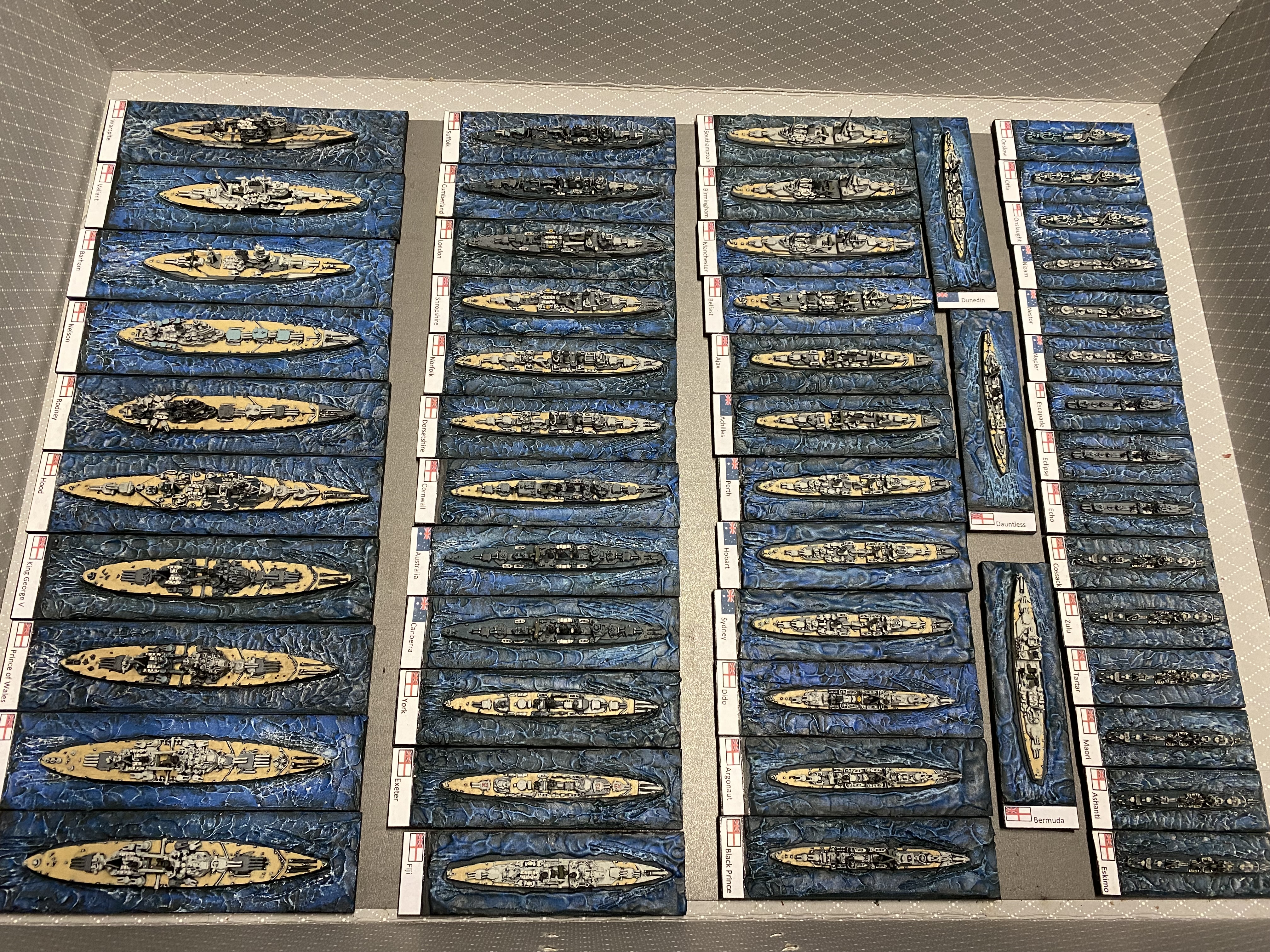
The entire Royal Navy fleet consists of 79 models in total, most of which fit snugly in one A3 storage box although the carriers and a handful of battleships have had to find a home alongside some of the overflow from the US and Japanese fleets:


Next up will be the completed merchant and transport ships, only a dozen or so, and then the Italian and French fleets to complete the project. 

Monday, 14 August 2023

US Navy Fleet Completed

Following on from my earlier promise not to drag out too many posting for this project lest I turn this into a naval wargaming blog, here are the recently-completed sixty-nine ships comprising my US Navy fleet. 

First off, three Iowa class battleships in the Iowa, Missouri and New Jersey. I have always thought this is one of the most beautifully designed classes of battleships and they are the most expensive under the Nimitz rule system at 48 points each, compared to the Yamato's 45 points and an average of around 35 points for most other battleships. It was a particularly memorable experience to be able to spend an hour or so fossicking through the Missouri in Pearl Harbour a few years ago:


The South Dakota, seen here with her sisters Indiana and Alabama, are to my eye also beautifully designed and pack quite a punch:


Next up the North Carolina and Washington alongside the USS Texas:


The US Navy camouflage system was quite easy to follow and again I purchased some "authentic" US Navy colour sets from Lifecolor. Decks were painted blue throughout most of the war, and Measure 22 complemented with a Navy blue hull makes for some quite dark colour schemes. Where I was forced to used this I used another earlier war US Navy colour called Ocean Blue, just to lighten things up a little as on the Pennsylvania below, seen here alongside the Mississippi, Colorado and Nevada:


I completed six Baltimore class heavy cruisers including the Baltimore, Boston, Quincy, Canberra, Pittsburgh and Saint Paul. The Canberra was actually named in honour of the Australian County class cruiser which had been lost operating alongside the US Navy in 1942 and was the first US warship named after a non-US capital city. The second USS Canberra was commissioned a couple of weeks ago in Sydney which is the first time a commissioning ceremony for a US Navy warship has been held outside the US:


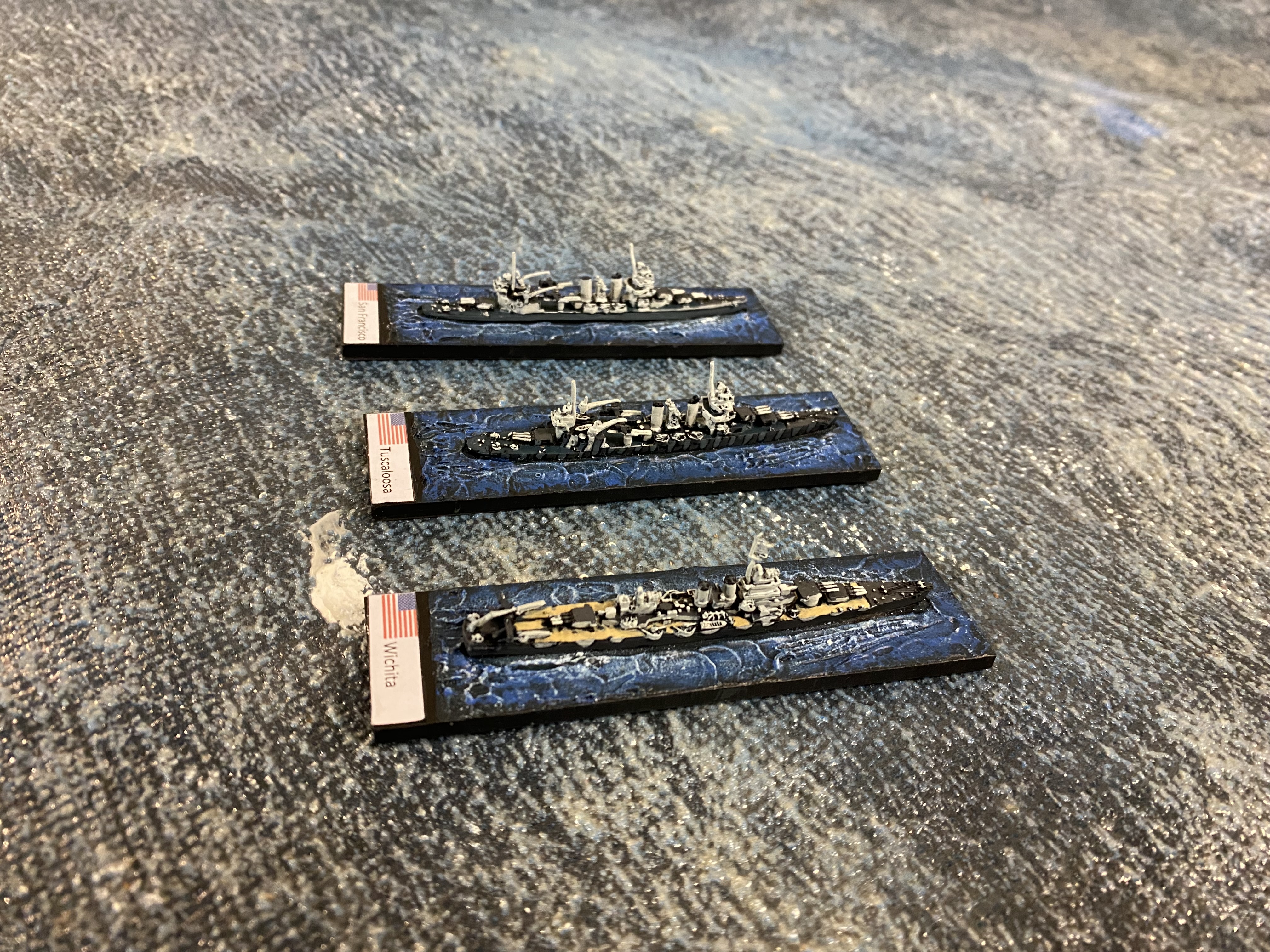
Below are two New Orleans class heavy cruisers in the San Francisco and Tuscaloosa, alongside the one-of-a-kind Wichita:


The Northampton, Chicago and Houston:


and the Portland and Indianapolis, alongside the light cruiser Detroit. The Indianapolis is famous for delivering the components for the atomic bomb that was to be dropped on Hiroshima, and was sunk by a Japanese submarine four days later. The 600 survivors had a terrible time and it is estimated that between 40 to 150 were taken by sharks:


The four Brooklyn class light cruisers here are Brooklyn, Philadelphia, Honolulu and Helena: 


With three Cleveland class cruisers in Cleveland, Miami and Colombia:


And three Atlanta class light cruisers in Atlanta, Juneau and San Diego:


I completed fifteen destroyers in total, with six Fletcher class destroyers; the Fletcher, Radford, Jenkins, Ross, Laws and Pritchett:


Three Benson class destroyers with the Benson, Madison and Laffey, and three Porter Class with the Porter, Phelps and Moffett:


And finally three Bagley class destroyers with the Bagley, Blue and Henley:


While I was looking up the colours for the Porter Class destroyers I stumbled across the story of the USS William D. Porter, a Fletcher class destroyer and what became known as the "unluckiest ship in the Navy". Unlucky is probably being a little generous as its voyage to escort the Iowa on its mission, in strict secrecy and radio silence, to transport Roosevelt to the Tehran conference began with the William D. Porter flailing an anchor which destroyed the lifeboat mountings and railings of a ship moored alongside. 

Joining the taskforce the following day, the William D. unfortunately let loose a depth charge which exploded, causing the Iowa and all the other escorts to scatter in the belief they were under U-boat attack. In one report I read  the Captain of the destroyer messaged the Iowa to explain what had happened and was subsequently chastised for breaking radio silence. Either way, the following day the task group decided to demonstrate their anti-aircraft drill to Roosevelt, to be followed up by a mock torpedo attack on the Iowa. While three out of the four torpedoes launched by the William D. Porter were the correct dummy torpedoes, the fourth was a live torpedo. Unsure now what to do with a live torpedo heading toward the Iowa with the US President on board, but also cognisant of not breaking radio silence again, the ship decided to signal the Iowa using a signal lamp but unfortunately sent the wrong message that the destroyer was about to reverse rather than it had launched a live torpedo. Luckily the torpedo detonated harmlessly behind the Iowa and Roosevelt must have seen the funny side as he apparently subsequently commuted the sentence of the sailor responsible, there being no other charges laid.

Next up are five Gato class submarines, the Gato, Cod, Darter, Flasher and Wahoo. There was no way I could resist including a submarine named Wahoo:


One of the most difficult things at times to follow was the US Navy's doctrine of renaming ships that were under construction for those that were lost. On reflection this is quite a clever tactic as it not only helped raise additional funding at home but must also have completely demoralised the Japanese when they thought they had sunk a ship, only to see its namesake re-emerge but with bigger and better capability. I know it demoralised me a little when I realised I had initially purchased the incorrect transfers from Flight Deck Decals for the Yorktown, seen here below in its Essex class reincarnation alongside the Essex herself, the Intrepid and the second of the carriers named Lexington.


The Hornet is another where I ended up with some spare decals, the below being the original Yorktown class carrier with a sister carrier Enterprise, alongside Ranger and Independence:


Finally, two fleet oilers Neosho and Sabine:


In the end the Japanese were overwhelmed not only by sheer numbers, but also the quality of what was being produced. There is no doubt that the US lost many lives at sea, and ships sunk are not always indicative of the lives that are lost to others that came under severe attack and managed to remain afloat, but I was genuinely surprised at how few ships above light cruiser the US Navy actually lost considering how heavily engaged they were throughout the Pacific. To my mind this just serves to underline how balanced the US Naval forces were and how severely the Japanese underestimated the industrial capacity of the United States.

Here is the bulk of the collection in its A3 storage box, with the carriers, fleet oilers and four of the battleships stored elswehere:


Next up, the last of the Royal Navy ships, and then the last two fleets in my Italian and French contingents.

Thursday, 20 July 2023

Imperial Japanese Navy Fleet Completed

I managed to complete the last ship in the IJN a few weeks ago so thought it was time to post a few photos for the sake of posterity. There are sixty-two vessels in this contingent so, rather than drag them out in a series of individual posts I thought I'd deal with them all in one hit, especially as I am still hopeful WWII naval will only be a relatively short segue before I plunge back into my ECW project. 

First off, the two giant battleships Yamato and Musashi, with their massive 18" guns that can inflict a lot of damage:


Followed by the Kongo, Nagato, Hiei and Kirishima. Like so many of the Japanese battleships apart from the Yamato class, the Kongo was a pre-WWI design. It was actually designed and built in the United Kingdom, and launched in 1912. The agreement was for the Japanese to take the design and use it as a blueprint for future constructions so it is quite ironical that the British designs were subsequently used against them:


I purchased a set of WWII Japanese naval colours which contains such exotic colours as Sasebo grey, Kure grey and so on, which are all different shades of grey used in the various shipyards after which the colours have been named. I took some time therefore to dig into which ships were constructed in which shipyards and applied the relevant shade of grey. The remaining battleships are the Ise, Hyuga, Fuso and Yamashiro, with the Hyuga post its conversion to a hybrid battleship carrier:


The Japanese heavy cruisers were very good, most being of a relatively modern design and launched in the 1930s. Below are the Tone, Chikuma, Takao, Atago and Chokai:


Followed by the Aobo, Kinugasa, Mogami, Mikuma and Myoko:


With the Ashigara and Kako completing the contingent of heavy cruisers:


By contrast the Japanese light cruisers were of an earlier vintage and generally outclassed by their US Navy counterparts. Below are the Kitakami, Oi (I have always loved that name), Jintsu, Tenryu and Tatsuta:


The Kitakami and Oi were converted into torpedo cruisers and carried forty tubes each, a lot more than the usual six that is found on most other light cruisers, and can therefore wreak havoc if they survive long enough to get close. 

Next up are the Katori and Kashima, two training ships which are seriously under-gunned and would struggle against a decent destroyer, alongside the Kuma and Kubari:


With the Agamo, Tama, Nagara and Natori completing the contingent of light cruisers:


Also completed are fifteen destroyers, with the Makinami, Yugumo, Onami, Asashio, Asagumo and Oshio:


The Nenohi, Hatsuharu, Wakaba, Teruzuki, Akuzuki, and Niizuki:


And the Suzutsuki, Wakatsuki and Hatsuzuki. The Japanese destroyers were mostly pretty good and, to be fair, many of the light cruisers were really only intended to act as flagships to flotillas of destroyers.


I also completed a supply ship in the form of the Tatekawa Maru, a fleet oiler:


and four submarines with the I-17, I-19, I-26, and I-29. 

These 'B-Class' submarines all carried a Yokosuka E14Y seaplane for spotting purposes, which I have modeled on two of the submarines. As I was painting them I wondered how many unlucky pilots either lost their bearings or returned to the correct spot to find the submarine had submerged and buggered off. The I-17 was actually the first Axis ship to shell mainland United States. It surfaced off California and tried to shell a fuel storage facility but only managed to damage a pier and a pump house. It did however trigger a mass hysteria event which caused the city of Los Angeles to believe it was under aerial attack the following night, resulting in the air defences showering ten tons of shrapnel and unexploded ordnance on the city. Quite understandable given the uncertainty of the times and not dissimilar to episodes elsewhere.

Finally, and well done if you have got this far, I completed seven aircraft carriers. Below are the Taiho, Zuiho and Shoho, the Taiho with its steel-reinforced flight deck and the latter in Midway colours, all courtesy of Flight Deck Decals:


Next the Hiryu and Soryu:


and finally the Kaga and Akagi:


Here are the latter two next to a pencil, just to give an idea of scale:


The planes are very fiddly, not just to paint but to glue in place without ruining the decal on which they are attached. On average I am finding that larger ships such as battleships, carriers and heavy cruisers are taking around three hours each to assemble, base and paint, light cruisers around two hours, and destroyers around fifty minutes to an hour each.

All up then the Japanese fleet is comprised of sixty-two vessels, all of which except the carriers fit nicely into one of my usual storage boxes:


The carriers will probably join the US and Royal Navy carriers in a separate storage box:


That's it for the Japanese fleet. One thing I did find interesting is that out of all the above ships only the battleship Nagato and heavy cruiser Takao survived the war. 

I'm currently completing the last dozen or so US Navy ships so will hopefully have that contingent completed within the next two to three weeks.